
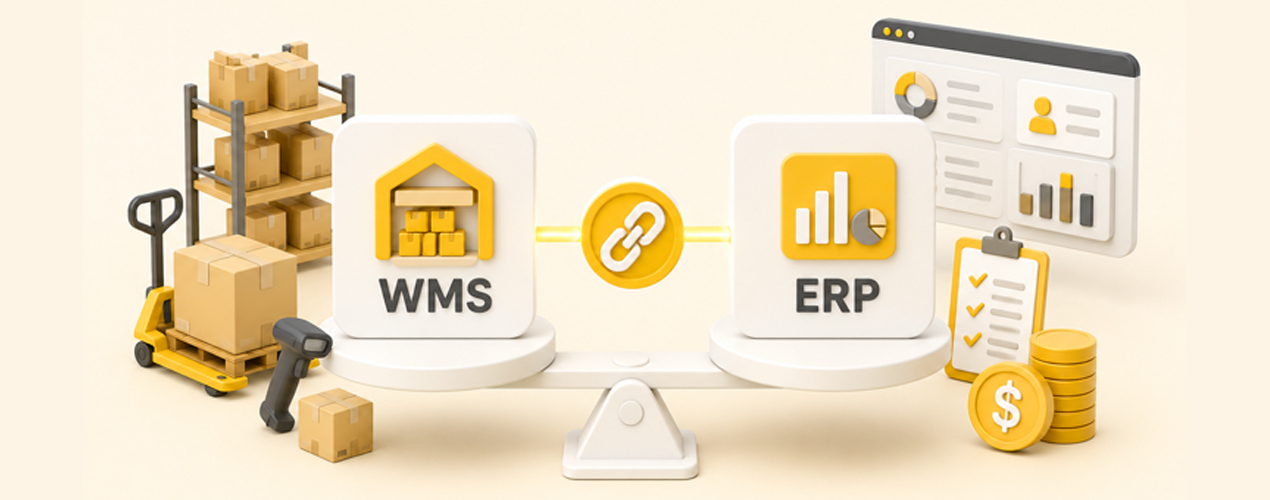
If you run a retail or ecommerce business in the UK, you have likely faced the question of whether to invest in a standalone warehouse management system (WMS) alongside your existing enterprise resource planning (ERP) software. Or perhaps you are starting from scratch and wondering if you need both. The answer is not always straightforward because the line between these systems has blurred over the years.
Many modern ERP platforms now include robust warehouse and inventory management modules. At the same time, standalone WMS solutions have grown to handle order management, purchasing, and even basic accounting. This overlap creates confusion and leads many business owners to either overspend on redundant tools or underspend on a system that cannot grow with them.
In this post we will break down the core differences between a WMS and an ERP, when you truly need both, and when a single integrated system like Vision ERP from Sapio Systems can handle everything without the friction of multiple vendors, data silos, and manual syncing.
WMS vs ERP: Quick Answer
A warehouse management system controls warehouse operations like picking, packing, bin locations, and stock movement. ERP manages broader business functions such as orders, finance, purchasing, customer service, and reporting.
Many UK retailers need both functions, but not always two separate systems. A modern platform like Vision ERP combines warehouse management and ERP in one system, helping businesses avoid duplicate data, sync issues, and extra software costs.
| Decision Factor | Standalone WMS | Integrated ERP with WMS (Vision ERP) |
|---|---|---|
| Best For | Businesses with highly complex warehouse operations and automation. | Businesses that want warehouse management and business operations in one system. |
| Primary Focus | Warehouse efficiency, stock movement, and fulfilment. | End to end business management including warehouse, finance, purchasing, sales, and customer service. |
| Warehouse Capabilities | Advanced warehouse functionality with deep operational controls. | Comprehensive warehouse management built into a complete ERP platform. |
| Business Visibility | Requires integration with ERP for a complete business view. | One shared database provides real time visibility across every department. |
| Software Required | Typically two or more connected systems. | One integrated platform. |
| Implementation | Integration projects may increase complexity. | Simpler deployment with fewer moving parts. |
| Ongoing Maintenance | Software updates and integrations require ongoing management. | Single vendor manages updates and platform improvements. |
| Long Term Costs | Higher when software, support, and integrations are combined. | Lower by reducing duplicate software and integration work. |
| Ideal Choice | Large operations with highly specialised warehouse requirements. | Retailers, wholesalers, manufacturers, and ecommerce businesses seeking operational efficiency. |
What a WMS Does That an ERP Often Doesn’t
A traditional warehouse management system is built for one thing: controlling the movement and storage of inventory inside a warehouse. It tracks every bin location, every pick path, every packing station, and every shipment. A good WMS can optimise put away, pick waves, replenishment, and even labour productivity. It is granular, real time, and focused on the four walls of your facility.
An ERP on the other hand is a broader business management system that covers finance, purchasing, sales, customer relationship management, and often inventory. But not all ERP systems are created equal. Many generic ERPs treat inventory as a simple quantity on hand. They do not manage bins, lot tracking, or pick pack ship workflows in any depth. If you run a high volume operation with thousands of SKUs and complex fulfilment processes, a basic ERP inventory module will quickly become a bottleneck.
This is where the “WMS vs ERP” debate begins. If your business is heavily warehouse driven, you might believe you need a best of breed WMS plus a separate ERP for accounting and order management. But that combination introduces integration challenges, duplicate data entry, and reconciliation nightmares.
The Real Cost of Running Two Separate Systems
When you use a standalone WMS plus an ERP, you pay for two software licenses, two sets of support contracts, and two teams that need to talk to each other. You also pay in time. Every time a product is received or shipped, that data must flow from the WMS to the ERP. If the integration breaks, your inventory numbers go out of sync. You end up with overselling or stock-outs.
Many businesses attempt to bridge this gap with custom middle-ware or third party integration tools. That works until an update on one side breaks the connection. Then you are chasing an urgent IT problem during peak selling season.
Sapio Systems saw this pain point clearly when building Vision ERP. They designed Vision not as a generic ERP with a lightweight warehouse add on, but as a fully featured platform that includes a true warehouse management system. Vision WMS handles bin control, stock transfers, direct dispatch for supplier orders, and real time inventory visibility. Because it is built into the same system that manages your orders, customers, and finances, there is no data lag and no integration to maintain.
When a Standalone WMS Makes Sense
There are still scenarios where a separate WMS might be the right choice. If you run a massive distribution centre with hundreds of pickers, complex automated material handling, and advanced labour tracking, a dedicated WMS like Manhattan or Blue Yonder may offer functionality that no ERP can match. But these are enterprise class systems with enterprise class budgets. Most UK retailers and ecommerce businesses do not operate at that scale.
Another case is when you already have a mature ERP that you cannot or will not replace. If your accounting and order management are deeply embedded in a legacy system, adding a standalone WMS that integrates via APIs may be the most practical path. However, you then inherit the integration burden described above.
For growing businesses that need speed, flexibility, and a single source of truth, an all in one system like Vision ERP eliminates the trade offs.
The Benefits of an Integrated ERP and WMS
When warehouse management and ERP live on the same platform, several things happen that directly improve your operations and bottom line.
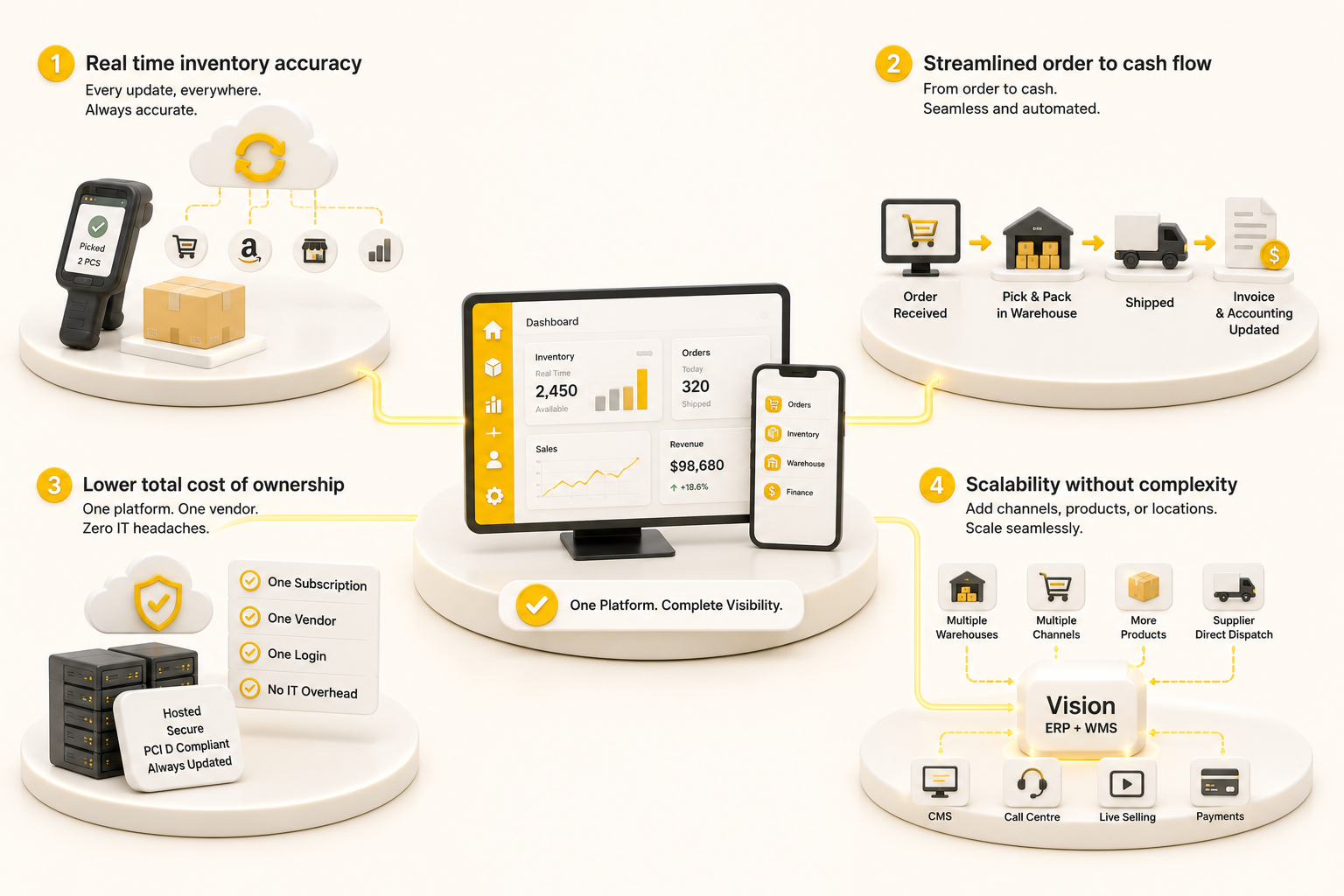
Real time inventory accuracy: As soon as a picker confirms a pick on a handheld device, that quantity is deducted from available inventory across all channels. Your website, your marketplace listings, and your internal reports all reflect the same number. No batch syncs, no nightly updates, no manual corrections.
Streamlined order to cash flow: The order enters through your website or marketplace integration. It flows automatically to the warehouse module where it triggers a pick wave. Once shipped, the invoice updates the accounting module without any human intervention. This means faster reconciliation and fewer errors.
Lower total cost of ownership: One subscription. One vendor to support. One login for staff. Sapio Systems positions Vision as a platform that “becomes your IT too” because they handle hosting, security, PCI D compliance, and continuous updates. You do not need an internal IT team to manage server infrastructure or integration code.
Scalability without complexity: As you add more channels, more products, or more warehouse locations, Vision scales. The warehouse management module can handle multiple bins, rack locations, and even direct dispatch from suppliers, all within the same system that manages your CMS, call centre, live selling, and payments.
When You Need Both Systems
The answer depends on the depth of functionality required.
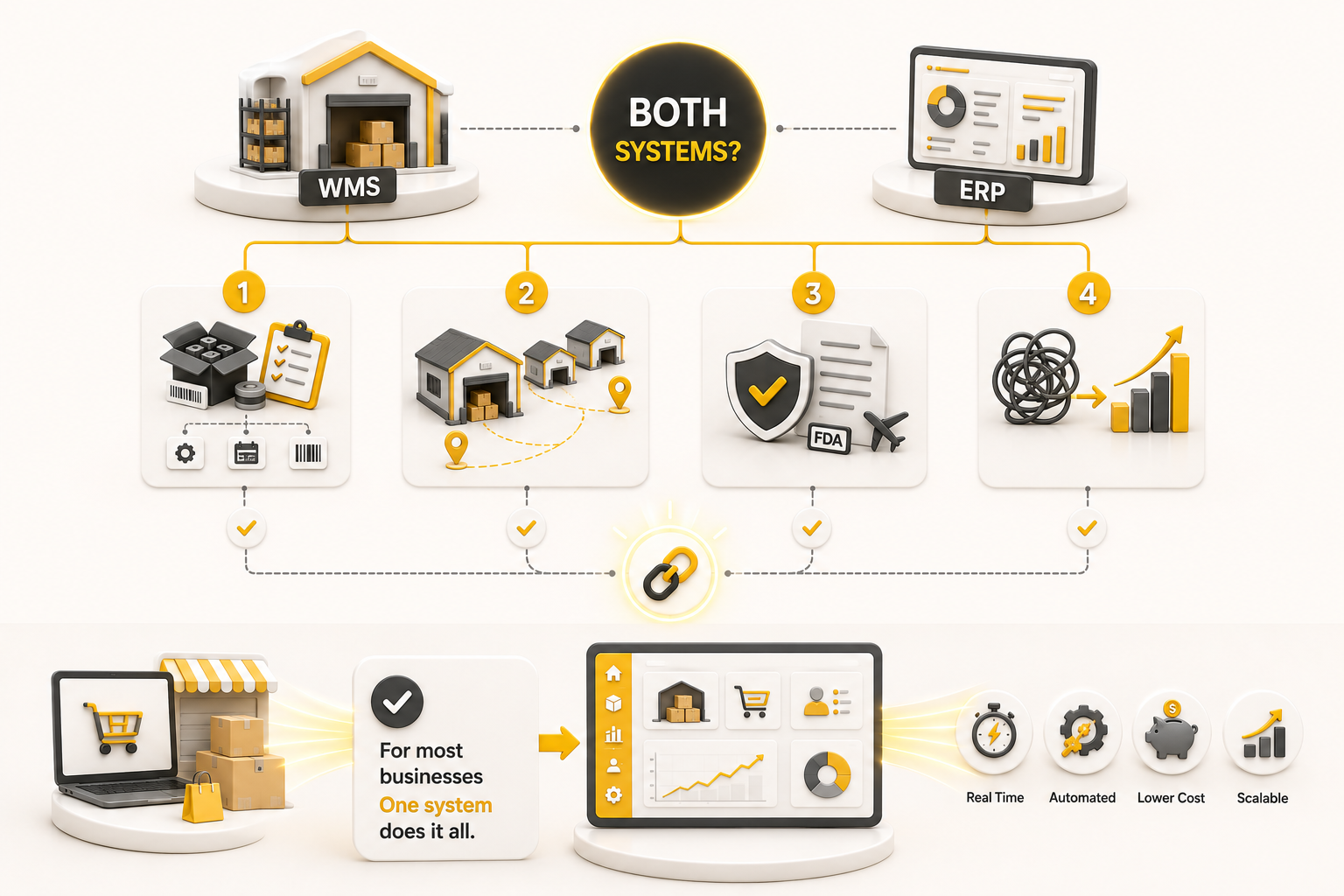
You likely need both if:
- Your warehouse involves highly specialised processes like kitting, expiry date tracking, or serial number traceability that your ERP cannot support.
- You operate multiple large warehouses with different systems already in place and switching to one platform would be disruptive for years.
- You have unique compliance requirements such as FDA lot control or aerospace parts tracking that demand a dedicated WMS.
For the vast majority of UK retailers, wholesalers, and eCommerce businesses, the answer is no. You need one system that does both well. That is exactly what Vision ERP delivers.
What Sets Vision ERP Apart for Warehouse Management
Vision includes a proper WMS module, not a bolt on inventory tracker. It gives you stock control by bin location, the ability to fulfil orders from the most efficient location, and direct dispatch where you can send supplier orders straight to customers without ever touching your warehouse. This is especially valuable for businesses that operate a dropship model alongside stocked inventory.
The platform also integrates with major marketplaces like ChannelAdvisor and third party logistics providers. You can manage products and orders across Amazon, eBay, and your own website from a single dashboard. That same dashboard connects to payment gateways such as PayPal, Stripe, and Acquired.com.
Sapio Systems designed Vision to be mobile first. Warehouse staff can pick, pack, and ship using handheld devices or tablets. Customer service agents can process phone orders and manage returns from any device. The cloud architecture means your team works from wherever they are, with no VPN required.
Making the Right Decision for Your Business
If you are evaluating a new WMS or ERP, start by mapping your current processes. How many orders do you ship per day? How many SKUs do you manage? How many warehouses or bins do you use? Do you need real time visibility across sales channels? Do you want to reduce IT overhead?
Write down the three biggest pain points in your current system. If they are integration headaches, duplicate data entry, or lack of real time inventory, then an integrated ERP with a strong WMS module is the clear answer. If your pain points are specific to advanced warehouse automation like voice picking or robotic integration, you may need a specialised WMS.
But remember that the market has moved. Modern ERP platforms like Vision are no longer just accounting tools with a side of inventory. They are fully featured operations platforms that include customer facing websites, CMS, warehouse management, call centre, live selling, marketplace integrations, payments, and support.
Next Steps
Sapio Systems offers Vision ERP as a complete business systems partner. We do not just sell software; we help you migrate your data, set up your workflows, and provide dedicated support packages with service level agreements built around your needs.
If you are tired of managing two systems that do not talk to each other, or if you are still using spreadsheets to track warehouse operations, consider a conversation with Sapio. They can show you how Vision handles everything from a single login, from product uploads to customer delivery.
Request a demonstration to see how Vision WMS and Vision ERP work together as one system. No integration fees, no data sync issues, just one platform that grows with you.