
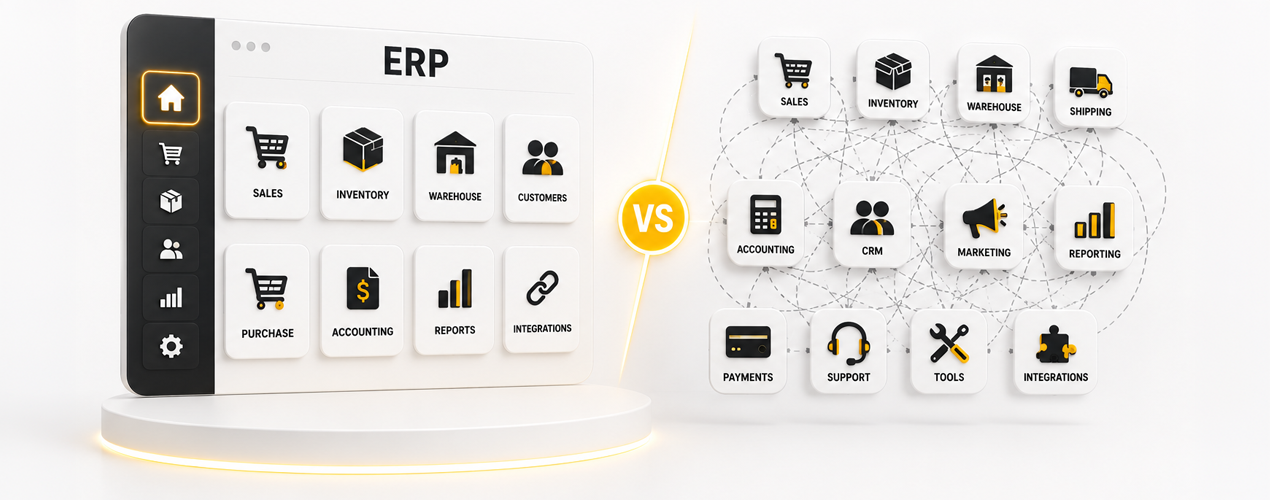
The choice between an All in One ERP platform and a collection of separate software tools is one of the most consequential decisions a growing company can make. On the surface, multiple point solutions appear to offer flexibility and specialisation. In practice, the cost of connecting, maintaining, and reconciling these tools often overwhelms the perceived benefits.
An All in One ERP is a unified system that manages core business functions including CRM, Warehouse Management, ecommerce, financials, and reporting within a single database. Multiple Tools refers to a best of breed approach where organisations select individual applications for each function and connect them through integrations or middleware.
Quick Overview
| Factor | All in One ERP Platform | Multiple Separate Tools |
| Initial Setup Cost | Higher upfront investment | Lower initial cost |
| Monthly Software Costs | Consolidated pricing | Multiple recurring subscriptions |
| Operational Efficiency | High due to shared workflows | Lower due to disconnected systems |
| Reporting Visibility | Centralised real time reporting | Fragmented reporting |
| Integration Dependency | Minimal | Heavy reliance on integrations |
| Administrative Work | Reduced manual processes | Increased manual coordination |
| Scalability | Strong long term scalability | Complexity increases over time |
| Staff Productivity | Higher workflow efficiency | Frequent system switching |
| Inventory Accuracy | Improved operational visibility | Higher risk of inconsistencies |
| Long Term Operational Cost | Usually lower over time | Often increases significantly |
Why Businesses End Up Using Multiple Tools
The path to a fragmented software stack is rarely intentional. It usually begins with a specific problem. A company needs a website, so they choose an eCommerce platform. They need to track inventory, so they add a WMS. They need to manage customer relationships, so they purchase a CRM. Each decision makes sense in isolation.
Over time, the collection grows. Teams are hesitant to replace tools they know intimately. There is a fear of vendor lock in and a belief that specialised tools are always superior to a generalist platform. The psychology of loss aversion plays a strong role here. A business owner who has invested months learning an accounting system is reluctant to abandon it.
However, this incremental approach ignores a fundamental reality. A business is a system, not a collection of parts. Optimising each component independently does not guarantee that the whole operates efficiently. In fact, it guarantees friction at every interface.
The Hidden Costs of Using Separate Software
The most dangerous costs are the ones that do not appear on a vendor invoice. These hidden costs accumulate silently and erode profitability over time.
Integration maintenance consumes substantial resources. Every time a third party application updates its API, the connection between your tools can break. Diagnosing these failures requires specialised technical staff or expensive consultants. This labour cost is rarely budgeted for upfront.
Data reconciliation is another invisible tax. When your inventory levels in the eCommerce system do not match the warehouse management system, someone must investigate and correct the discrepancy. This manual effort happens weekly or even daily in multi tool environments.
Context switching penalties affect every employee. A customer service representative checking order statuses must log into one system for the order, another for the shipping status, and a third for the customer history. Each login breaks focus and slows response time. Aggregate this across your entire team and the productivity loss is substantial.
Security surface area expands with each new tool. Every application is a potential vulnerability. Managing user permissions and access controls across a dozen vendors creates administrative overhead and risk
ERP vs Multiple Tools: Real Cost Breakdown
The following table illustrates the typical annual cost difference between a multi tool stack and an All in One ERP over a three year period. Costs are based on a mid market business with average operational complexity.
| Cost Category | Multiple Tools (5 Systems) | All in One ERP |
| Annual Subscription Fees | $60,000 | $72,000 |
| Integration Middleware | $18,000 | $0 |
| IT Support for Maintenance | $35,000 | $8,000 |
| Manual Reconciliation labour | $24,000 | $3,000 |
| Employee Training (Year 1) | $15,000 | $5,000 |
| Total Year 1 Cost | $152,000 | $88,000 |
| Total Year 3 Cost | $411,000 | $248,000 |
The data shows that while the All in One ERP may have a higher subscription cost, the elimination of integration, maintenance, and reconciliation labor results in significant savings over time. By year three, the difference exceeds $160,000.
What Is Total Cost Of Ownership (TCO) In ERP?
TCO is the full cost of owning and operating a software system over its useful life. For an All in One ERP, TCO includes the subscription or license fee, implementation, training, ongoing support, and any internal labour required to manage the system.
For multiple tools, TCO must account for every individual subscription, integration middleware, the labour to maintain connections, the cost of reconciling data across systems, and the productivity loss from context switching. The table above shows a realistic TCO comparison.
The key insight is that subscription fees are only a fraction of the real cost. When you calculate ERP ownership costs properly, the unified platform almost always wins on total cost over a multi year period. This is why an ERP cost analysis that ignores integration and reconciliation labour is dangerously incomplete.
Why Disconnected Software Slows Business Growth
Growth amplifies the weaknesses of a fragmented software stack. As order volume increases, the latency between systems becomes more noticeable. A product listed as available on the website might actually be out of stock in the warehouse. This leads to cancelled orders and unhappy customers.
Expanding into new sales channels becomes a nightmare. Each new marketplace or wholesale partner requires a new integration. The integration queue grows faster than the development team can handle. Opportunities are delayed or lost entirely.
Reporting accuracy suffers. Executives cannot trust a single dashboard because the data is pulled from multiple sources with different update schedules. Decisions are made on stale or conflicting information. The business loses agility at the moment it needs it most.
An All in One ERP removes these bottlenecks. When a sale is made on any channel, inventory updates instantly across the entire system. Reporting reflects a single source of truth. Adding a new sales channel is a configuration change rather than a development project. Growth becomes easier rather than harder.
Vision ERP vs Multiple Tools
Many ERP systems focus heavily on technical architecture while overlooking practical business operations.
The Vision platform from Sapio Systems was designed by experienced business operators who understand the real cost of complexity. It combines CMS, Warehouse Management (WMS), customer services, live sales tools, reporting, marketplace integrations, and a lightning fast eCommerce website into a single operational view.
Where a multi tool approach requires managing separate vendor relationships, contracts, and roadmaps, Vision offers a single partnership. Where multiple systems force employees to chase data across applications, Vision centralises everything into one interface.
Because the platform is unified, it is ready to deploy without extensive integration projects. Implementation focuses on configuration and training rather than custom coding and middleware setup. This reduces IT risk and shortens the time to value.
This comparison is not about claiming superiority in every situation. It is about recognising that when a platform meets the core criteria of scope, usability, and operator design, the total cost of ownership shifts decisively in favour of unification.
Real Business Scenario Comparison
Consider a growing eCommerce business processing thousands of monthly orders across multiple marketplaces. A customer places an order on the company website.
With Multiple Tools, the order enters the ecommerce platform. An integration script sends it to the WMS. The WMS sends inventory updates back to the ecommerce platform. The accounting system receives financial data from both. If any step fails, the order is stuck. An employee must manually intervene to move the order forward. The customer waits longer, and the company pays for the labour.
With Vision ERP, the order enters a single system. Inventory is deducted immediately. The warehouse receives the pick request in the same interface. Accounting sees the transaction in real time. Customer service can answer questions about the order without leaving their screen. The process flows seamlessly because there are no walls between the functions.
This scenario plays out hundreds of times per day. The friction of multiple tools compounds. The ease of a unified system accelerates everything.
Signs Your Business Has Outgrown Multiple Tools
How do you know when it is time to move from separate systems to an All in One ERP? Look for these patterns.
You spend more time managing integrations than using the tools – If your IT team or operations manager spends several hours per week fixing broken connections or moving data between systems, your software stack has become a maintenance burden.
Inventory discrepancies are a weekly occurrence – When your warehouse shows stock that your website says is unavailable, or vice versa, the cost of data inconsistency is already eroding profits. This is a clear sign that when to move to ERP is now.
Your team complains about logging into too many systems – Frequent context switching is not just an annoyance. It lowers productivity and increases error rates. If employees need more than three logins to complete a single customer order, your stack is too fragmented.
Adding a new sales channel takes months – If expanding to a new marketplace requires a custom integration project, your business is losing revenue while competitors onboard faster. This is a primary reason companies seek replace multiple software tools with a unified platform.
You cannot get a reliable financial report without manual work – When your profit and loss statement requires data pulled from three different systems and reconciled in a spreadsheet, you have a reporting problem that an ERP solves immediately.
If any two of these signs apply to your business, the case for consolidation is strong. A software stack consolidation reduces complexity and accelerates growth.
Choosing Between ERP and Multiple Tools (Actionable Advice)
This section gives you a specific process to evaluate your own business. You can complete these steps in under an hour with your current subscription data and a team member who manages your systems.
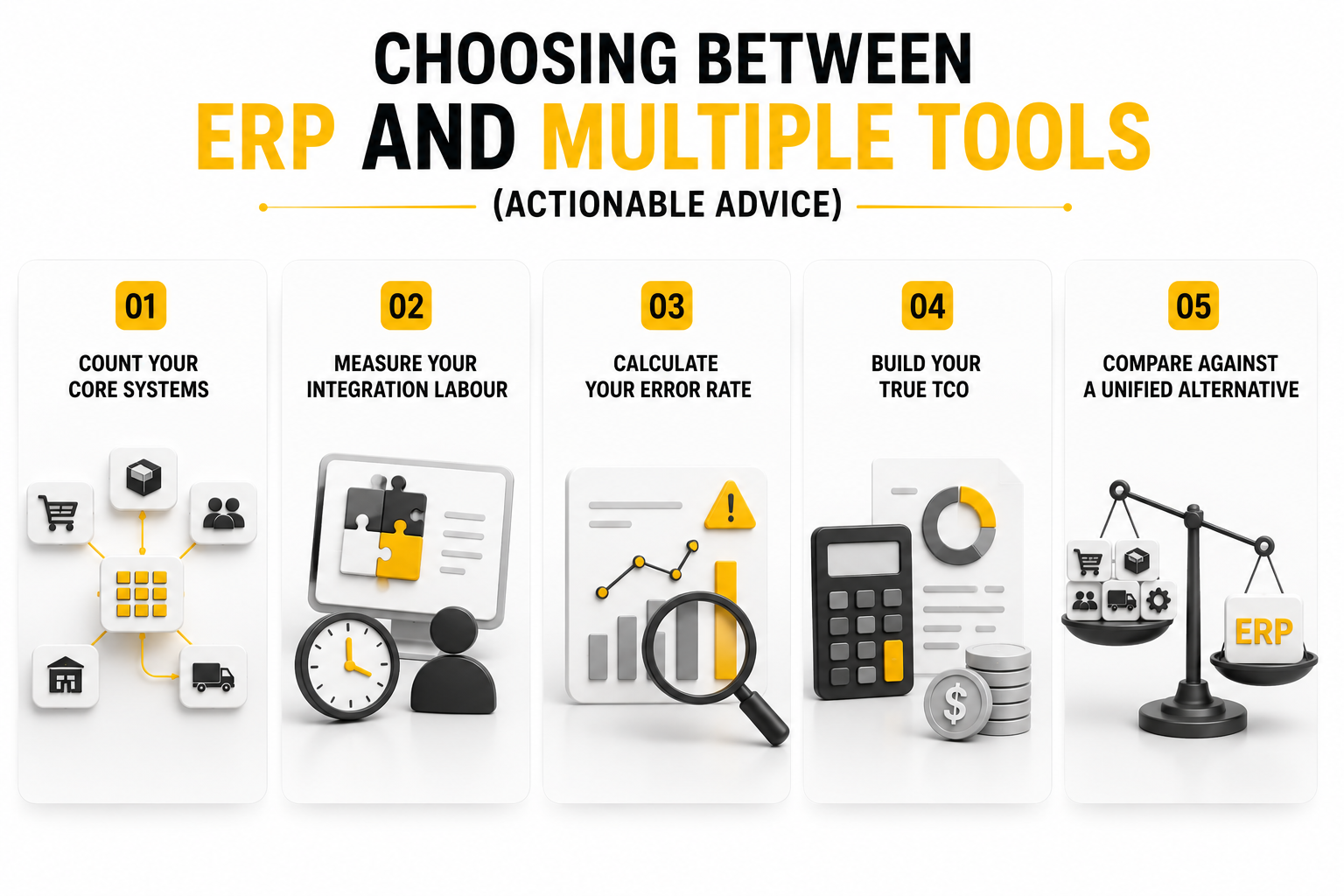
Step 1. Count Your Core Systems
Make a list of every software tool you use for operations, sales, inventory, customer management, accounting, and reporting. Include middleware or integration platforms. If you have more than three systems that must talk to each other to fulfil a single customer order, you are in the complexity zone. This is the first signal that an All in One ERP could reduce your overhead.
Step 2. Measure Your Integration Labour
Identify the person or team responsible for making your systems work together. Ask them how many hours per week they spend fixing broken integrations, moving data manually between systems, or reconciling mismatched information. Multiply that number by 50 weeks per year. Multiply the result by the fully loaded hourly cost of that employee. This is your annual integration labour cost. If this number exceeds $15,000, the financial case for a unified platform is strong.
Step 3. Calculate Your Error Rate
Review your records for the last 90 days. Count the number of order errors, shipping mistakes, or invoice discrepancies that were caused by data mismatches between your systems. Include cancelled orders, compensation to customers, and chargebacks. Estimate the total financial impact. This is a direct cost of your fragmented stack that a unified system would eliminate.
Step 4. Build Your True TCO
Add up your current subscription costs for every tool. Add your integration platform fees. Add the labour cost from Step 2. Add the error cost from Step 3. The result is your True Total Cost of Ownership for your current multi tool environment. Write this number down.
Step 5. Compare Against a Unified Alternative
Request a proposal from an All in One ERP provider like Sapio Systems. Compare the annual cost of the unified platform against your True TCO. Do not forget to include the value of faster decision making, improved employee satisfaction, and the elimination of integration headaches. If the unified platform costs less or is within a reasonable margin while offering better data consistency, the right decision is clear.
Using these five steps, you can move from guesswork to a data driven decision. The question of what saves cost becomes a calculation rather than an opinion.
Conclusion
The question of what saves cost between an All in One ERP platform and multiple tools is answered by looking beyond subscription fees. The hidden costs of integration maintenance, data reconciliation, context switching, and lost agility far outweigh any perceived flexibility of a multi tool stack.
An All in One ERP platform like Vision from Sapio Systems delivers predictable costs and reliable operations. It is built to eliminate the friction that slows business growth. It provides a single source of truth that every department can trust.
For organisations ready to stop patching systems together and start operating with unified data and consistent logic, the unified platform is the clear winner. The cost savings are not just financial. They are operational and strategic. A single platform allows you to focus on your customers, your products, and your growth rather than the burden of managing a disconnected software ecosystem.