

Replacing a retail ERP in the UK is a 28-to-40-week project that should be sequenced against the trading calendar (peak runs mid-October to mid-January), led by a single business owner inside the company, and timed for a February or post-Easter go-live. Around 81% of IT projects fail; the 19% that survive in retail share specific habits, not specific vendors.
At a glance
| NUMBER | WHAT IT MEANS |
|---|---|
| 81% | IT projects that fail — Standish CHAOS Reports baseline |
| 28–40 weeks | Realistic end-to-end UK retail ERP migration window |
| £5m–£100m | Turnover band where stack-collapse usually beats best-of-breed |
| 12 weeks | Minimum stable trading buffer to leave before the next peak |
| 0–5,000 | Orders a UK live-commerce ERP can take in 10 minutes during a hot broadcast |
Most retail ERP migrations fail because they were planned by IT and run during the same months the business is trading hardest. The 81% project failure figure that vendors quote, drawn from the long-running Standish CHAOS Reports, hides a more useful truth: the migrations that survive look very different from the ones that collapse, and almost none of the difference is technical.
This guide is for UK operations and finance leaders weighing a retail ERP replacement in 2026. It assumes you know what an ERP is, you have a current system that is groaning, and you want to know which questions to ask before signing.
When should you replace your retail ERP?
| DIRECT ANSWER You should replace your retail ERP when the platform is throttling commercial decisions you would otherwise make, not when users complain. The signal is operational, not technical. |
The honest answer is later than most vendors imply. Replacing a system that broadly works imposes a year of operational risk the business absorbs while it is also trying to grow. Five tells worth taking seriously.
You cannot see real-time stock across channels at the moment you need to commit to a campaign. Buying a slot, planning a live show or pushing a flash sale becomes a coin-flip on inventory. UK retailers in the £10m to £40m turnover band reach this point around year three of a Brightpearl, Sage 200 or Mintsoft setup as their channel count grows.
You hold extra buffer stock because the system cannot be trusted at peak. Capital sits in the warehouse against an inventory error rate the operations team has stopped trying to fix. The cashflow tax of bad data quietly compounds.
New sales channels keep getting pushed because integration takes a quarter each. TikTok Shop, a marketplace expansion, a livestream pilot, an Amazon Vendor switch. Each requires bespoke integration work and the queue never shortens. Three-channel retailers stay three-channel retailers because the technology has decided for them.
Finance month-end is a manual reconciliation across separate tools. The CFO knows the numbers come out, but cannot easily pressure-test them. VAT, MTD compliance and Companies House filings are produced from spreadsheets bridged across three or four systems.
Someone on the team’s only job is keeping the legacy system upright. A developer or sysadmin who knows where the bodies are buried, often near retirement, increasingly nervous about touching anything that works.
A system that is not technically broken can still be commercially failing. Take a £25m UK homewares retailer running a Sage 50 plus Magento plus Mintsoft setup with bolt-on tools for customer service and email. Stock lives in three places. Finance reconciles them monthly. The head of operations has quietly stopped considering livestream sales because nobody believes the inventory feed will hold up under load. That business does not need an upgrade. It needs a different platform.
Why do 81% of retail ERP projects fail in the UK?
| DIRECT ANSWER Five causes account for almost all UK retail ERP project failures: peak-season sequencing, underestimated data debt, no single business owner, the implementation partner running the project, and phase-two features that are deferred and never delivered. |
The Standish CHAOS data lumps all IT projects together, which makes the headline fairly useless. When the failure modes are separated for retail and consumer-facing ERP migrations, a tighter pattern emerges.
- Migration sequenced through peak season. The single biggest cause. The business signs in January, the project takes nine months, and go-live lands in October as Black Friday traffic ramps. The implementation team gets blamed for issues the calendar created.
- Underestimated data debt. The new system inherits SKU data, customer records, supplier contracts and historical orders mended for a decade. Cleaning the data is the first eight weeks of any honest project, and most plans give it two.
- No clear business owner. The COO believes finance owns it, the CFO believes operations owns it, and the IT director runs the project without commercial pushback. Outcomes drift toward the implementation partner’s defaults.
- The implementation partner running the project. Capable partners, conflicted incentives. They earn on hours, not outcomes, and the buyer’s lack of internal capacity becomes the project’s constraint.
- Phase-two features deferred until after go-live, then never delivered. Live commerce, drop-ship orchestration, marketplace API, advanced reporting. The roadmap that was sold quietly becomes a line in the renewal conversation.
The 19% that succeed share a small set of habits. The migration is timed against the trading calendar, not the financial year. A single business leader inside the company owns the project with veto power over scope and timing. The data audit happens before vendor selection, not after. Phase-two features are written into the implementation contract with go-live dependencies, not promised verbally. The implementation partner is selected for retail experience at the buyer’s volume, not for vendor certification.
Which retail ERP is right for your business in 2026?
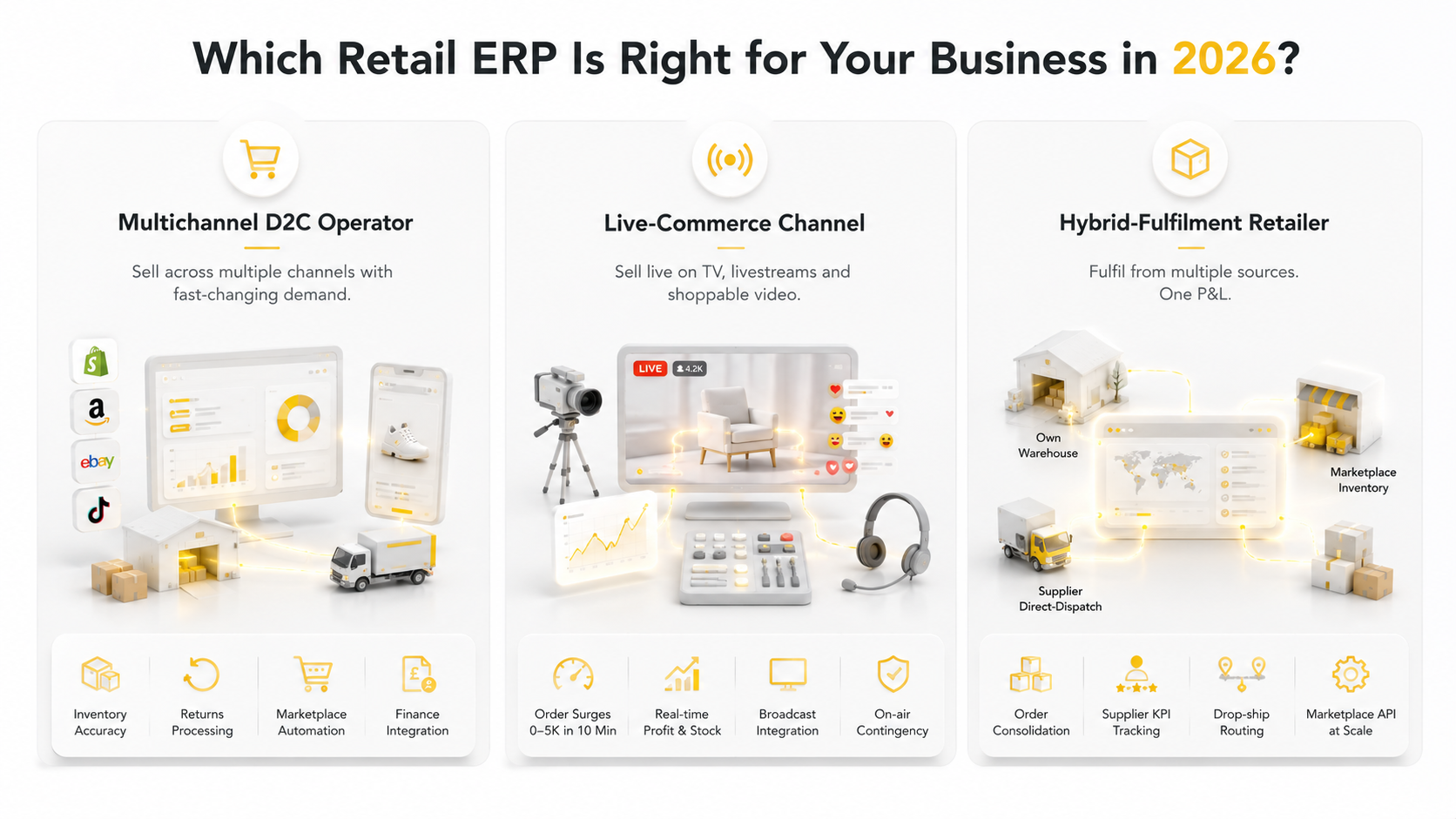
| DIRECT ANSWER The right retail ERP depends on your buyer profile. Three are worth distinguishing in UK retail today: the multichannel D2C operator, the live-commerce channel, and the hybrid-fulfilment retailer. Generic comparisons that ignore this split produce wrong shortlists. |
The multichannel D2C operator
Turnover roughly £5m to £40m, selling through Shopify, Amazon, eBay and increasingly TikTok Shop, with a small or outsourced warehouse and a few hundred SKUs. The classic Brightpearl, Mintsoft or Linnworks customer at the smaller end, the Brightpearl, Sage 200 or NetSuite customer further up. Pain concentrates on inventory accuracy across channels, returns processing, marketplace listing automation and finance integration. The ERP question for this profile is rarely about features; it is about how often the channel mix changes and whether the platform follows.
The live-commerce channel
UK retailers selling through TV broadcast, livestream and shoppable video. ShopOnTV, broadcasting on ITV1, STV and Freeview 89, is the visible face of this segment in the UK; TikTok Shop’s live push has created a new layer below it. Pain points are different and more specific. Order surges of zero to five thousand inside ten minutes. Real-time producer-side telemetry on profit-per-minute and stock allocation. Direct integration to broadcast graphics hardware. On-air contingency modes when a payment processor or warehouse system goes down mid-show. Generic ERPs cannot do these things; pure-play livestream platforms cannot do the back office. Most operators in this segment run a stitched-together stack and accept the fragility.
The hybrid-fulfilment retailer
Retailers splitting fulfilment across own warehouse, supplier direct-dispatch and marketplace inventory in one P&L. Common in £20m to £100m homewares, garden, DIY and lifestyle retailers. Pain clusters around order consolidation maths (one parcel or three?), supplier KPI tracking, drop-ship routing rules and the integration cost of maintaining a marketplace API at scale. Mintsoft and Linnworks own pieces of this story; Mirakl and ChannelEngine own the marketplace orchestration; Brightpearl and NetSuite address slices. None of them connects all three fulfilment modes into one operational view, which is why most operators in this segment quietly run two systems and pretend it is one.
Should you choose stack-collapse or best-of-breed?
| DIRECT ANSWER Stack-collapse usually wins for UK retailers between £5m and £80m turnover, where integration burden is itself a cashflow line. Best-of-breed earns its keep above £100m, or where bespoke product complexity demands specialist tools in each layer. |
The defining architecture choice in 2026 is not cloud versus on-premise; that argument is over. It is whether to assemble a stack of best-of-breed tools (CMS, OMS, WMS, ESP, customer services, payments, analytics) and integrate them, or to consolidate the lot into one platform.
Best-of-breed wins when the operations team is large enough to manage six or more vendor relationships, the technical team can absorb integration work, and the business genuinely needs a specialist in each layer. Common at £100m turnover and above, and at retailers with bespoke product complexity, regulated categories or unusual fulfilment.
Stack-collapse wins when the operations team is small, when integration burden is itself a cashflow line, and when consistency between front-end and back-office matters by the second rather than by the day. Common at £5m to £80m turnover, and increasingly the right answer for live-commerce operators where the gap between an order being placed on screen and an allocation hitting the warehouse cannot be five minutes.
| “Best-of-breed is a luxury that scales with team size. Stack-collapse is the answer when the integration burden is itself the bottleneck.” |
The decision is operational, not philosophical. A retailer with fifteen people in operations cannot run a six-vendor stack, and a retailer with eighty cannot extract enough value from a single platform that pretends it does everything. The honest middle position is to consolidate the operations-critical tools (CMS, OMS, WMS, customer services, live commerce) and keep specialist best-of-breed only where it earns its keep.
How long does a retail ERP migration take in the UK?
| DIRECT ANSWER A realistic UK retail ERP migration runs 28 to 40 weeks across five stages: diagnostic, data audit, build, UAT and go-live, and stabilisation. Go-live should target February or post-Easter, never October. The single most expensive mistake is sequencing the project through Black Friday. |
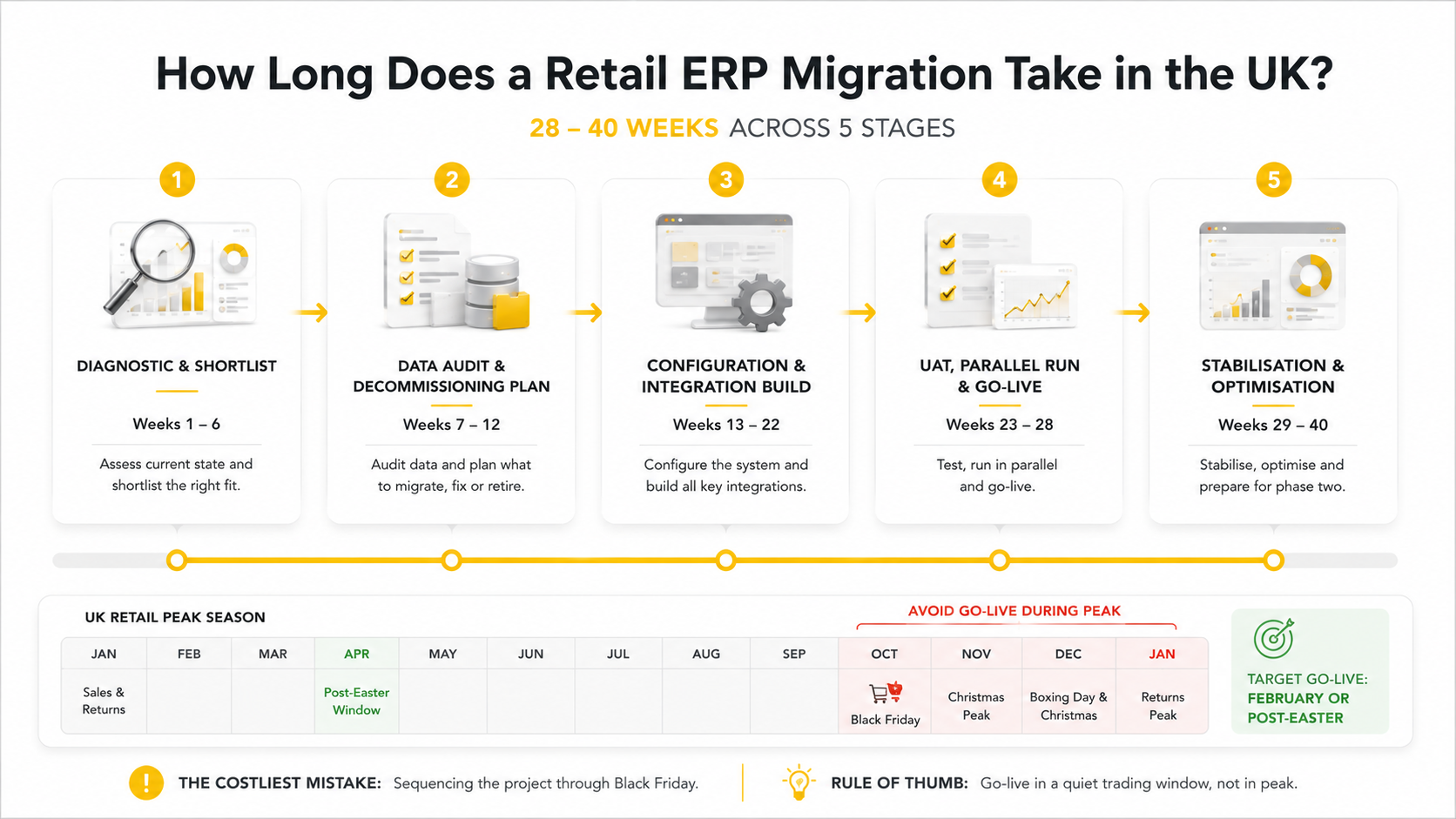
UK retail peak runs from mid-October through mid-January, including Black Friday, Christmas, Boxing Day, January sales and the returns peak. Working backward from a post-Easter go-live:
Stage 1 — Diagnostic and shortlist (weeks 1 to 6)
The business assembles a single-page operating diagnostic: current stack, integration points, data quality, where the system is throttling commercial decisions, and what phase-two looks like in two years. Shortlist three to five vendors against this diagnostic, not against a generic RFP. Use the buyer-profile lens above; do not let vendors talk you into the wrong category.
Stage 2 — Data audit and decommissioning plan (weeks 7 to 12)
The most undervalued stage. Audit the SKU master, customer master, supplier master and historical orders before signing anything. Decide which data migrates clean, which migrates dirty with a remediation plan, and which gets archived. Map every existing tool to retire-on-day-one, retire-in-phase-two, or keep-and-integrate. This is the conversation most projects defer; it should be the conversation that informs vendor selection.
Stage 3 — Configuration and integration build (weeks 13 to 22)
The build phase. Vendor selection is locked, contract signed, statement-of-work agreed with explicit phase-two deliverables and dependencies. The internal team’s job is sponsorship, escalation and weekly business sign-off, not project management. The external partner’s job is delivery against agreed scope.
Stage 4 — UAT, parallel running and go-live (weeks 23 to 28)
User acceptance testing against scripted operational scenarios drawn from the diagnostic in stage one. Parallel running for two to four weeks, where both systems process orders and finance reconciles. Go-live on a quiet trading day, ideally a Tuesday in late spring, with the business owner on the bridge and the implementation partner contracted to be physically present.
Stage 5 — Stabilisation and optimisation (weeks 29 to 40)
The phase the contract usually does not cover and the business often skips. The first ninety days post-go-live surface the integration issues UAT did not catch. Reserve internal bandwidth for it. Plan phase-two features to begin only after week 40, which gives twelve weeks of stable trading before the next peak.
What does a UK retail ERP cost over five years?
| DIRECT ANSWER Five-year TCO varies too much by volume and vendor to publish a single figure honestly. The pattern most retailers underestimate is integration and engineering, which is usually the largest line in best-of-breed stacks and the smallest in stack-collapse retail platforms. |
A useful TCO comparison looks at five buckets across five years.
| Cost component | Best-of-breed stack | Generic cloud ERP | Stack-collapse retail platform |
|---|---|---|---|
| Software licences | Distributed across six to eight vendors; hardest to negotiate down | Single largest line; volume-priced and rises with growth | Single line; modular pricing |
| Implementation | Per-tool parallel projects; lowest total but highest co-ordination cost | Largest single implementation; highest external services spend | Mid-range; fewest moving parts |
| Integration and engineering | Largest line over five years; rises with each new channel | Mid-range; vendor partner ecosystem absorbs some | Smallest; integrations are platform features |
| IT FTEs to maintain | Largest internal cost; needs specialists per tool | Mid-range; needs ERP admin and integration engineer | Smallest; vendor maintains platform |
| Phase-two features | Often re-bought as separate tools | Quoted as add-ons or higher tier | Included or modular within platform |
Patterns matter more than absolute numbers. The pattern most UK retailers underestimate is integration and engineering: rarely a contract line item, usually the largest five-year cost in a best-of-breed stack and the smallest in a stack-collapse platform.
If you would like a working five-year TCO model run against your current stack as a benchmark, the Sapio team will produce one alongside a Vision platform walkthrough. It is a useful comparison reference point regardless of whether Vision turns out to be the right answer for you.
How do you de-risk a retail ERP migration?
| DIRECT ANSWER The 19% of retail ERP projects that succeed share eight specific habits: calendar-first sequencing, a single internal business owner with veto power, data audit before vendor selection, contractually-binding phase-two scope, named UK references at the buyer’s volume, costed five-year TCO from each shortlisted vendor, scripted operational UAT, and reserved post-go-live bandwidth. |
Sequence the project against the trading calendar rather than the financial year. Migration planning that ignores Black Friday is migration planning that has not happened.
Appoint a single business owner with veto power over scope and timing. Almost always the COO or FD; rarely the CIO. The wrong owner is the most common reason projects drift.
Audit the data before selecting the vendor. The remediation cost of bad SKU and customer data should inform what you buy.
Write phase-two features into the contract with go-live dependencies. Verbal promises about live commerce, drop-ship orchestration or marketplace expansion convert into renewal conversations otherwise.
Ask vendors for UK references at your turnover band, in your sector, with the specific functionality you need. Generic case studies translated from US dollars are not references.
Insist on a costed five-year TCO from each shortlisted vendor, not just year-one licences. The shape of the cost curve over five years matters more than the headline.
Run UAT against scripted operational scenarios, not generic test cases. The scenarios that matter are the ones that broke your last system: peak Friday afternoon, return surge in early January, new SKU launch with pre-orders.
Reserve twelve weeks of post-go-live bandwidth that the project plan does not formally use. The phase-five issues will appear; pretending otherwise is the most common cause of phase-two never happening.
What should be on your retail ERP shortlist?
| DIRECT ANSWER The criteria that matter are native capability for your buyer profile, named UK references at your volume, modular pricing, an implementation timeline that keeps go-live out of peak, and a vendor culture that treats phase-two as a contractual deliverable rather than a sales conversation. |
The criteria to ignore. AI claims without specific use-case detail. Customer-count vanity metrics that do not segment by sector or volume. US case studies presented as global references without UK trading specifics. “Cloud-native” as a tagline rather than as an architecture choice. “Industry-leading” as a self-description.
Sapio’s Vision platform is built for two of the three buyer profiles: live commerce (ShopOnTV’s ITV1, STV and Freeview 89 broadcast operation runs on Vision) and hybrid fulfilment (own warehouse via VisionWMS plus drop-ship plus marketplace through one license). For the multichannel D2C profile without broadcast or hybrid-fulfilment ambitions, Brightpearl, Sage 200 or NetSuite may be the right answer; ask your shortlist the buyer-profile question first and the feature question second.
A practical closing thought
The retailers who get this right have one trait in common, and it is not budget or vendor choice. It is that someone inside the business, usually the COO or FD, owns the migration the way they own a peak-season trading plan, with the same numerical discipline and the same private suspicion that the worst outcome is a slow-motion failure nobody calls out in time. The system you are replacing was bought by someone who thought it would last twelve years. The system you are buying will be replaced by someone who thinks the same. Build for the next twelve years, not the next twelve months. Choose the buyer profile honestly. Sequence against the calendar that pays your wages. And own it from the inside, because no implementation partner can.
If the conversation here is one you would rather have with the Sapio team directly, including a comparative walkthrough of your current stack against the Vision platform, write to hello@sapiosystems.com or call +44 20 4538 7000.
Frequently asked questions
How long does a retail ERP migration take in the UK?
A realistic UK retail ERP migration runs 28 to 40 weeks from diagnostic to stabilisation, with go-live ideally six to ten months before the next Black Friday peak. Faster timelines exist but typically defer data quality work or phase-two features that resurface as renewal-conversation issues twelve months later.
When should we start a retail ERP project to avoid peak season?
The safest UK trading-calendar pattern is to start the diagnostic in January or February, lock the vendor by April, build through summer and autumn, and go live the following February or post-Easter. That gives twelve weeks of stable trading before the next October peak begins.
What is the difference between a retail ERP and a retail operating system?
“Retail operating system” is Brightpearl’s positioning for an operations-focused platform without strong native finance. A retail ERP includes finance and accounting natively. Stack-collapse retail platforms like Sapio’s Vision combine operations and finance with live commerce and hybrid fulfilment built in.
Do we still need a separate WMS if our ERP includes warehouse management?
For most UK retailers below £80m turnover, no. A modern retail ERP with native warehouse management handles bin management, intelligent picking, courier integration and direct-dispatch routing. Separate WMS tools tend to earn their keep above £100m turnover, in regulated categories, or with unusual fulfilment such as 3PL passthroughs.
What is a realistic five-year TCO for a UK retail ERP?
Five-year TCO varies too much by volume and vendor to publish a single figure honestly. The pattern most retailers underestimate is integration and engineering, which usually accounts for the largest line in best-of-breed stacks and the smallest in stack-collapse platforms. Ask any shortlisted vendor for a costed five-year model.
Can we keep our existing ecommerce platform when we replace the ERP?
Often yes, but the integration cost over five years usually exceeds the cost of moving to a platform’s native storefront. Sapio’s Vision platform includes a custom-built fast-loading website module specifically because retailers replacing an ERP frequently find their existing Shopify or Magento setup is the next bottleneck.
Is Sapio’s Vision platform a Brightpearl alternative?
Yes for retailers in the live-commerce or hybrid-fulfilment buyer profiles, and for UK multichannel D2C operators outgrowing Brightpearl’s £20m–£40m ceiling. Vision adds a native broadcast and livestream module (VisionLIVE) and a unified warehouse-plus-drop-ship-plus-marketplace layer Brightpearl does not have natively.