TV shopping creates a unique operational problem because demand, stock, payments and fulfilment all have to react to a live broadcast. The software needs to connect those processes quickly enough for the business to make decisions while the show is still running. TV shopping looks effortless on screen. A presenter holds up a product, and within minutes the graphics show how many viewers have ordered. Stock has to be reserved while thousands decide. The systems behind the show cannot pause for a spreadsheet, and they decide whether the format makes money or burns it.
What Is TV Shopping Software?
TV shopping software is the technology used to manage orders, inventory, payments, fulfilment and customer activity generated through television and live broadcast selling. TV shopping software has to be a single system of record for a channel selling live on air. It captures orders from every route, reserves stock against a live show, processes payments and drives fulfilment. That is broadcast retail software in plain terms.
Why TV Shopping Strains Retail Systems
Broadcast retail is not simply ecommerce with a television audience. The demand pattern, stock allocation and order processing requirements are different.
QVC’s corporate site records the UK launch in October 1993, and broadcast retail has stayed on British screens ever since. Social commerce accounted for nearly £6.5 billion of UK retail sales in 2025, and growth is expected to accelerate in 2026, according to GS1 UK. Live shopping on social platforms shares the same DNA: presenter led, urgent, real time. The operating models differ.
A broadcast channel runs on a curated schedule with a producer controlling the gallery; a social stream follows an algorithm and lives on engagement. Both put the same pressure on orders, stock and payments.
What makes the format hard is convergence. A viewer can watch television, hold a phone and browse the same product, and the order can come from any of those places. They trust a person they can see.
When a Show Goes Live, Orders Arrive From Everywhere at Once

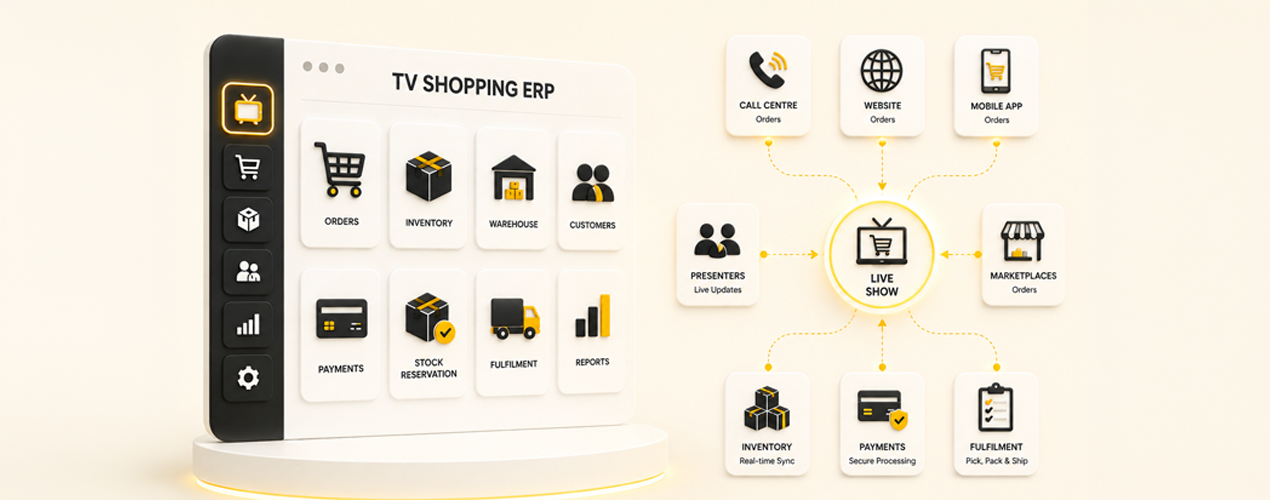
An ERP for TV shopping has to take orders as they land, because there is no quiet moment to catch up later. During a live show the phone lines open, website traffic spikes and the app pushes a notification.
Call centre agents take orders while the presenter is still talking, because the viewer is on the line and the moment to convert is now. Website and app orders flow in automatically, and marketplace listings add another feed on top. This is why TV retailers increasingly need broadcast and online sales to operate through the same omnichannel retail ERP software, so the phone sale and the web sale are handled identically.
Every extra system in this chain recreates the double entry problem that affects any retailer selling through several channels: orders rekeyed, stock adjusted by hand, and nobody sure which record is right. The fix is not more careful typing. It is order management software built around one order pool.
One distinction matters. An order management system orchestrates orders, tracking status and routing fulfilment. Necessary, but not the whole operation. An ERP extends the same record across inventory, warehouse, customers, payments and finance, so an order is not an island with a status.
Stock Must Be Real While the Cameras Are Rolling
A TV shopping ERP has to show stock that is real in the moment. Viewers decide in seconds, and scarcity does the persuading. A running count of items left creates urgency, but only if the count is honest, because the presenter cannot fix a wrong number once it is on screen.
The answer is a single stock record shared by the TV gallery, the website, the marketplace and the warehouse. When an order lands, stock reduces instantly across every channel. That same record powers the inventory management that keeps the warehouse accurate without manual counts.
Fulfilment then becomes a question of where the product is. Some channels ship from their own warehouse with bin level management, using a warehouse management system that knows where every item sits; others send order data straight to third party suppliers.
Overselling is the fastest way for a TV retailer to lose trust, so the mechanism that stops it matters. Sellable stock is calculated live. The system starts with available stock, subtracts reserved stock, subtracts orders still being processed, then applies allocation rules. The number left over is what can be shown on air, and every order from every route moves it immediately.
Allocation rules carry the business judgement. A retailer may physically hold 5,000 units but release only 3,500 to a broadcast, keeping 1,500 back for web orders, customer replacements and later shows. Buffers like that protect margin and service levels without emptying the shelf elsewhere.
The logic also runs in reverse. A declined payment, a cancellation or a return puts units back into the sellable pool at once, so they can be reoffered before the show ends instead of sitting in a rejected order file.
Payments, Instalments and the Refund Cycle
Payment handling is where TV retail margins are won and lost. The card taken over the phone, the online checkout, the PayPal payment and the marketplace payout all need to be recorded against the same order and reconcile with finance in one step.
Instalments are not one thing. With a card instalment plan, the acquirer arranges the schedule and the retailer receives the full amount. With a buy now pay later provider, the provider holds the credit and settles net of fees. With a retailer managed plan, you carry the credit and track every instalment in the ledger. The system must support the model you choose, including refunds mid plan.
None of this works without secure processing. Phone payments need the same protection as online transactions, and fraud checks should run before dispatch.
The Whole Channel Needs One View
The people who run a TV shopping channel rarely see the same screen. The producer runs the gallery. The call centre takes orders. Customer service handles follow up. The warehouse picks and packs. If they work from different systems, the channel runs on guesswork and goodwill.
The producer’s screen shows more than what is selling. Orders per minute, units sold, stock remaining, conversion, average order value, payment success rate, cancellation rate and returns decide whether to extend a show or move on.
That screen only earns its keep when every order can be traced to the moment it was placed. The chain runs from show to product to broadcast time to offer, and each order taken during a segment carries those attributes. The system can then roll up orders, revenue, returns and contribution after product cost, payment fees and fulfilment, and put a profitability figure on the slot itself. Without that discipline, the graphics show live sales but nobody can say whether the slot made money.
Service teams need the full customer story in one place: what they ordered, how they paid and where the parcel is. That is exactly the gap the Vision platform from Sapio Systems was built to close, with a dedicated live TV sales module called Vision:LIVE that puts real time sales monitoring and direct TV graphics integration in the producer’s hands.
Returns follow the same rule. Some categories, like jewellery and fashion, see more than others, and the return flow matters as much as the sale.
What Should TV Shopping Software Integrate With?
A TV shopping operation is never one system. The website, the phone lines, the warehouse and the accounts all have a say in every order, and the software earns its keep by removing the hand offs between them. These are the connections that matter:
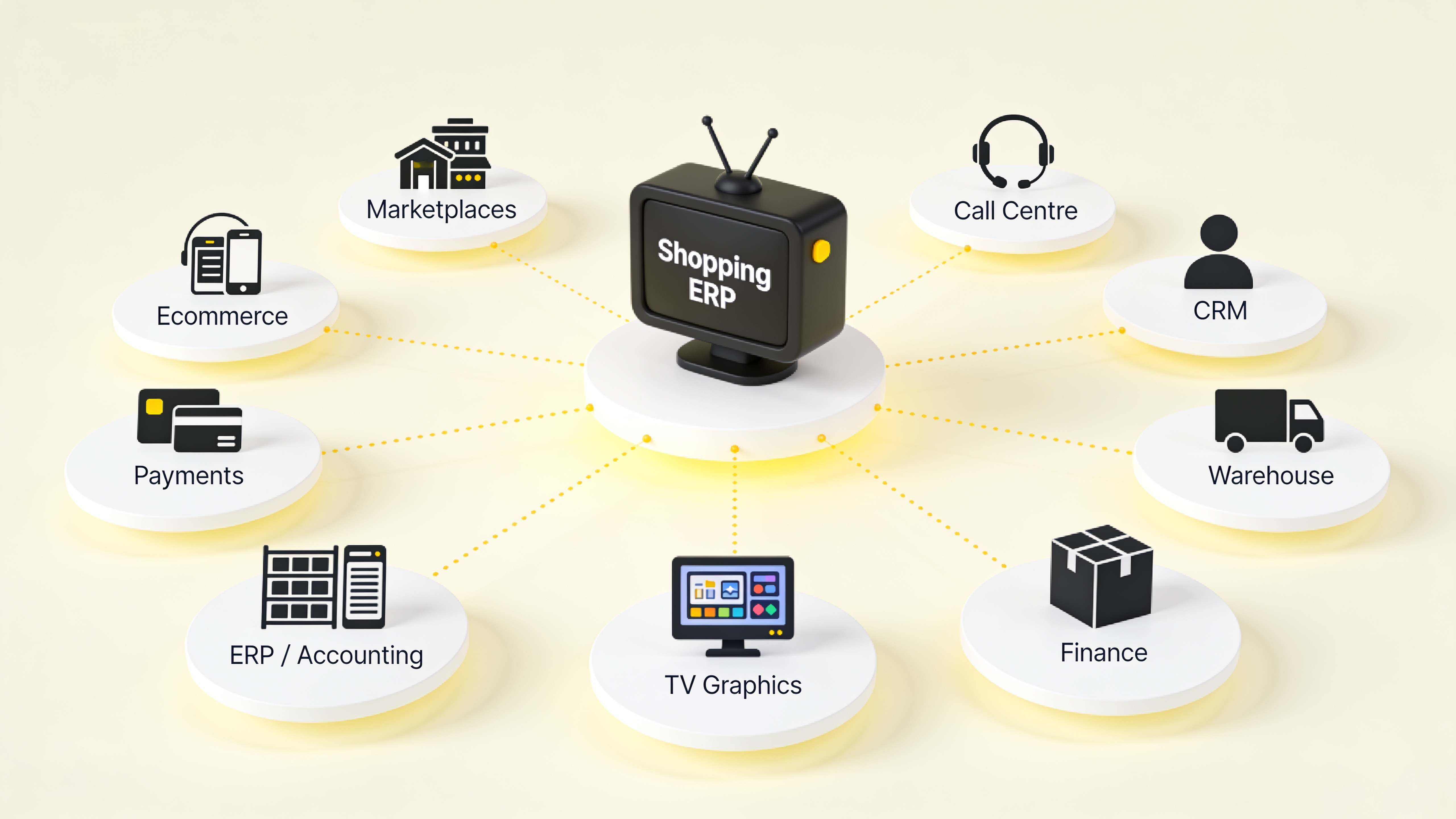
- Ecommerce platform: The website and app where online orders land need to share the same order pool as the phone lines, so nothing gets rekeyed.
- Marketplaces: Amazon, eBay and social shops add feeds on top, and every listing should draw from the same stock record.
- Call centre and telephony: Agents take the card while the caller is on the line, with the customer’s history and account credit already on screen.
- CRM and customer records: One customer file across phone, web and marketplace, so service teams see the full story in one place.
- Payment gateways: Phone and online payments need the same gateways and the same fraud checks, and instalment plans must be tracked the way they actually work.
- Existing ERP or accounting system: If you are not replacing everything at once, the new layer has to hand order and stock data to your current system cleanly, not run a parallel record.
- Warehouse management: Bin level picking, courier labels and dispatch run from the same stock record that the presenter sees.
- Fulfilment providers: Direct dispatch suppliers need order data sent straight to them, and their tracking needs to come back into the customer record.
- TV graphics: The on screen countdowns and sales graphics should draw from the same data as the producer’s panel, not from a separate feed.
- Finance and accounting: Payments, refunds and fees reconcile without rekeying, so the books close cleanly at month end.
If a vendor sells these as add ons, integration becomes your project. If they are one system, integration is the architecture.
What TV Shopping Requires Beyond Standard Ecommerce
A standard ecommerce platform handles web checkout well. TV shopping adds demands that appear nowhere else. The sections above already cover one order pool, real time stock, overselling protection, instalments and clean reconciliation. Three demands deserve their own line:
- Show scheduling integration: The system knows what is on air and when, and ties each slot’s orders back to that product and broadcast.
- Dynamic pricing and promotions: Countdown offers, bundle prices and live discount codes change without taking the channel offline.
- Continuity and autoship: Recurring orders for subscription products like beauty and wellness bill and ship on their own cycle.
The Bottom Line
The channels that grow are the ones whose operations stay calm when demand spikes. That calm is designed. When orders, stock and payments live in one system, a live show becomes a sales event, not a stress test. That is the principle the Vision platform from Sapio Systems was built on, and the reason its live TV module keeps the producer, the call centre and the warehouse on the same data.
If you run a TV shopping channel or a live streaming business, request a TV shopping demo and we will take your products through the full flow under load, from live order capture to payment in one screen.