
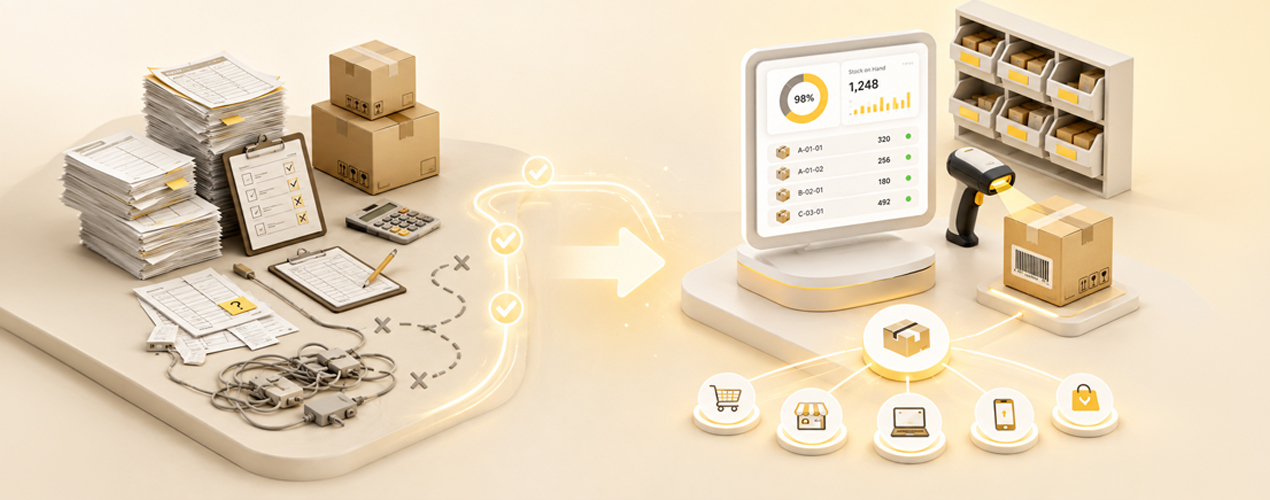
Every business that holds stock knows the ritual. Once or twice a year the warehouse closes and everyone counts units by hand, corrects the records, and calls it accurate. Then the numbers start drifting again.
Wrong stock levels are not a bookkeeping nuisance. They decide which orders ship, whether a customer comes back, and whether your cash sits in stock nobody wants while best sellers run empty. For most UK retailers, manual counting is not even a good way to keep records accurate.
This guide covers what actually works: cycle counting, perpetual records, barcode scanning, RFID where it earns its keep, and how to trace the leaks.
Why Counting Stock By Hand Keeps Letting You Down
Manual stock takes are slow, disruptive, and strangely unreliable. Studies put manual record accuracy between 65 and 80 per cent, so even after a full count, one in five records can still be wrong.
The core problem is that a physical count is a snapshot. It is accurate at the moment it ends, and stale after the first sale, return, or box moved to the wrong bin. The annual count finds symptoms; it does nothing to stop the causes. It is also expensive: a typical stock take takes between two and ten days, and a small operation with under 2,000 SKUs can tie up a team with receiving paused.
The ritual survives because it is familiar, but counting should become a check on the system, not the system itself.
Stop Counting Stock And Start Controlling Movement
Instead of periodically discovering what the stock is, capture every movement at the moment it happens. Every receipt, sale, transfer, return, and adjustment updates the record immediately. Most UK businesses sell through more than one channel: a website, eBay, Amazon, a TV channel, or a call centre, all drawing from the same stock, so each channel must read and update one shared record in real time.
When stock lives in a spreadsheet and every channel edits its own copy, discrepancies are guaranteed. A single source of truth underpins every other method in this guide, and it is what multichannel sellers need most.
Four Ways To Keep Stock Honest
Keeping inventory accurate is not about one big annual count. It comes from a handful of practical methods that work together to keep stock records reliable every day.
Why Cycle Counting Beats The Annual Stock Take
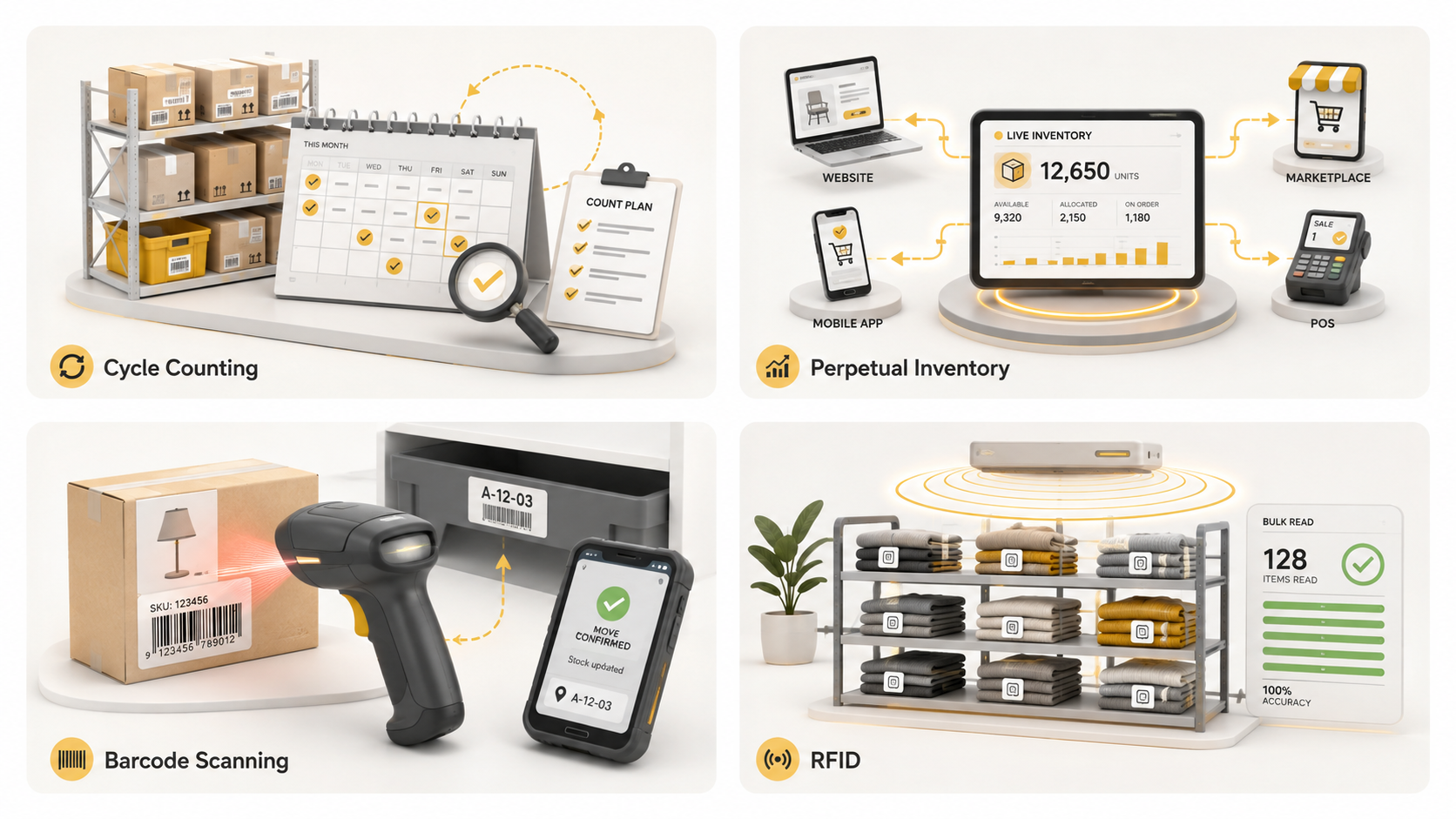
Cycle counting replaces the annual stock take. Instead of counting everything at once, you count a small slice of stock on a rolling schedule, and the whole exercise runs far faster when the system knows where every SKU lives, with no shutdown at all. Each count is a micro audit: small enough to run mid shift, frequent enough that errors surface in days rather than months.
The usual approach is ABC analysis. A items are your fastest selling or highest value lines, B items steady sellers, C items the long tail. Count A items weekly or monthly, B items quarterly, and C items once or twice a year.
Every SKU still gets counted each year, but the lines that matter most are checked constantly; well run programmes hold 98 to 99 per cent accuracy.
| Annual stock take | Cycle counting | |
|---|---|---|
| When | Once or twice a year | Continuous, on a rota |
| Warehouse impact | Closed sections, paused receiving | None, operations continue |
| Accuracy after count | Drifts within days | Held high all year |
| Error tracing | Hard, weeks of movement | Easy, recent and local |
| Labour | Bursts of heavy overtime | Steady, small slices |
Two practices make it work. Blind counts, where the counter does not see the system quantity first, so they cannot be nudged toward the record. And a variance rule: recount before adjusting, then find the cause. The adjustment fixes the record; the investigation fixes the process. Bin locations make all of this faster.
Perpetual Inventory Means Records That Update Themselves
Perpetual inventory is what makes “no manual counts” realistic. When an order is placed, it is reserved there and then, so two channels cannot sell the same last unit. When stock is received, the quantity updates, and transfers between bins or warehouses update both locations. Returns tell the system what to restock and where. This stops the failure mode most UK sellers fear: overselling.
A Brightpearl survey of UK retailers found 46 per cent had experienced stockouts that cost them sales, and IHL Group puts the combined damage of stockouts, overstock, and returns at more than a trillion US dollars a year. Around one in ten customers permanently switches supplier after a single stockout, more than half after repeated ones.
Reliable records make reorder points and safety stock trustworthy, because every sales channel reads and writes one stock record. Set a minimum per SKU and the system raises a purchase order or alerts your buyer when stock dips below it. If you drop ship, the record can trigger the order and update stock when the supplier ships.
Integrations decide whether this stays automatic. The record is only as live as its connections: eBay and Amazon need two way sync, couriers such as Royal Mail, Evri, and DPD need dispatch data, and the accounts package needs the valuation. When links are missing, someone rekeys numbers between systems, and rekeying is where accuracy goes to die.
Barcode Scanning Does The Counting For You
Barcode scanning is the cheapest way to turn manual movements into automatic records. A USB or Bluetooth scanner costs very little; any phone can be one. Every receive, pick, pack, transfer, and return involves a scan the system checks against what it expects. Receiving becomes a verification: mismatches surface at the door rather than at the year end.
Picking works the same way, catching a wrong pick before packing rather than after dispatch.
Location scanning completes the picture. When stock is put away, the scanner reads the bin label as well as the product, so the system knows where each unit lives. When picking, the picker scans the bin before the item.
This kills two classic errors: stock in the wrong place, and stock that exists in the system but cannot be found. Make location scans mandatory, and the record tracks position as well as quantity.
The principle is that the scan is the count. You are not adding counting to the day; you are removing the separate step entirely. A system with barcode support built in, such as Vision from Sapio Systems, turns this from a project into a switch you flip.
RFID Steps Up When Scanning Gets Too Slow
For most operations, barcode scanning is enough. RFID reads dozens or hundreds of tags at once, without line of sight, so a whole shelf can be verified in seconds. McKinsey research on RFID in retail found it lifted inventory accuracy to around 98 per cent and cut stockouts by 15 to 25 per cent, and case studies published through GS1 UK, including research from the University of Leicester, measured similar effects across ten retailers.
RFID earns its keep where the maths works: high value products, high volume operations, apparel with dense racks, or persistent shrinkage. Every tag costs money, so it is usually a second step. Fix the movement first, then decide whether scanning speed is the bottleneck.
Where Your Stock Records Actually Go Wrong
Accurate records depend on knowing why they go wrong, not just correcting them. Receiving errors top the list: goods arrive, paperwork lags, quantities differ from the invoice. Returns are second: items come back and sit in a corner, or get restocked to the wrong bin, while the system still shows them as sold.
Damaged stock is a quiet leak, set aside without a write off. Shrinkage adds a layer on top; industry estimates put retail shrinkage at about 1.3 per cent of UK sales, roughly £4.5 billion a year. And behind all of these sits data entry, a 6 typed as a 9 on a long shift. Operational errors like these often cost more than theft.
Control who can change the numbers. If any member of staff can edit stock from a phone or a spreadsheet, a well meaning correction becomes an unlogged error, the same gap that makes warehouses lose orders. Restrict adjustments to named roles, make significant changes require approval, and keep an audit trail.
The same rule applies to connected apps: let them read stock, but stop them from adjusting it on their own. When a variance appears, trace it to the step that allowed the gap; fixing the procedure fixes hundreds of future records.
Track Your Accuracy So It Never Drifts Back
For any count, take the SKUs that matched the record exactly, divide by the total counted, and multiply by 100. That is your inventory record accuracy. Start at 95 per cent and move toward 99 per cent, tracking the trend rather than the single number. Measure per bin zone and per ABC class, so the monthly report shows where to look.
A Realistic Plan To Drop Manual Counts
Week one: baseline. Count your A items, the 20 per cent of SKUs carrying most of the value, and fix the biggest discrepancies.
Week two: put barcode scanning on receiving and dispatch, where most errors enter.
Weeks three and four: start the cycle counting rota with blind counts on the A items.
Month two: automate. Set reorder points, build a returns process that restocks to the correct bin, and make adjustments a logged, approved act.
Month three: plan the year end. You still need a defensible stock valuation for your accounts, but clean cycle count history turns the year end check into a fast validation instead of a two day shutdown.
When choosing software, look for bin level tracking, barcode scanning, automated reorder points, and a shared stock record across every channel; whether you call it a WMS, or an ERP with a warehouse module, the label matters less than the capabilities. Inventory management software with these features, such as Vision from Sapio Systems, covers them all in one platform.
Quick Answers To Common Questions
How do you keep inventory accurate without manual counts?
Capture every stock movement at the source and check records with small, frequent counts. Barcode scanning, real time updates, and cycle counting on an ABC rota keep records accurate without a full count.
Why is my stock always wrong?
Usually receiving errors, returns that never get restocked, unrecorded damage, shrinkage, or data entry mistakes. Record every movement at the point it happens and investigate.
Do I still need an annual stock take for my accounts?
You need a defensible year end stock valuation. With a perpetual inventory system and disciplined cycle counting, the year end check becomes a quick validation of records you have verified all year.
Start Where The Money Leaks
You do not need to count every unit to trust your stock. Start with the A items, add scanning on receiving and dispatch, and let cycle counting keep the record honest all year. The annual stock take stops being the source of truth and becomes what it should be: a check on a system that is already working.
Sapio Systems builds Vision for exactly this situation. Their customers run real time inventory with bin level tracking, barcode scanning, and automated reorder points, maintaining 98.7 per cent stock accuracy as standard practice. Their team will show you around a live system and talk through your own numbers. A conversation costs nothing; a year of wrong stock does.