
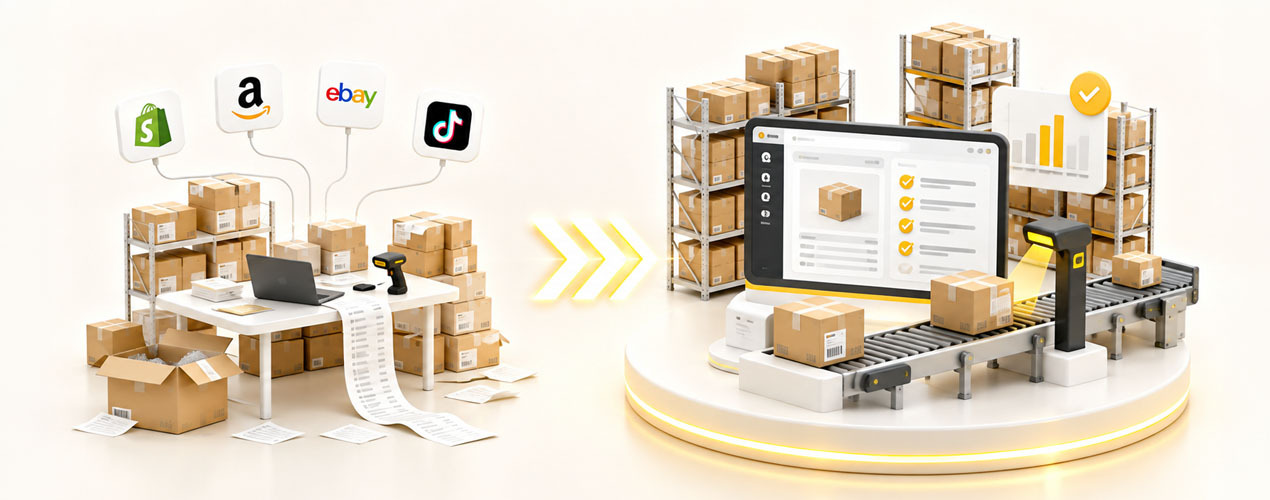
Ask five people when a small ecommerce business should invest in a warehouse management system and you will get five different answers. One consultant will tell you to buy one before you launch. Another will say wait until you hire a third person. A software vendor will tell you yesterday.
The honest answer is less dramatic. Most small ecommerce brands do not need a standalone WMS, but nearly all of them need to know the exact moment their current setup starts costing them money. That moment is not defined by a magic order count. It is defined by what being wrong is costing you.
This guide covers what a WMS actually does, the five signals that say you have outgrown manual fulfilment, and the cheaper middle path most growing UK ecommerce businesses miss.
The Quick Answer
A WMS earns its keep when manual processes start producing errors you can measure in pounds. For most small sellers, that point arrives somewhere between 50 and 100 orders a day, or when a few hundred SKUs across multiple sales channels stop fitting inside a spreadsheet and a memory.
Industry research on ecommerce fulfilment is consistent here: below that line, disciplined processes plus the stock tools built into your ecommerce platform are usually enough. Cross it, and WMS capability starts paying for itself through fewer mispicks, less time spent walking, and stock levels you can actually trust.
And when you do cross it, WMS functionality inside an all in one platform like Vision ERP beats a separate warehouse system for most small and growing ecommerce businesses. One subscription, one database, no integration to babysit.
What a WMS Actually Does for a Small Seller
A WMS does three jobs in plain English. It tells your team exactly where every item lives. It guides picking and packing so the right thing goes in the right parcel. And it keeps your stock numbers in sync across every channel in real time.
In practice that means scanning a barcode on a handheld device, following a pick list that names the aisle, bay, and bin, printing a courier label, and watching available stock drop on your website, Amazon, and eBay the moment the scan happens.
It replaces memory, paper, and spreadsheets with a single shared record. It is not robots and conveyors. A small ecommerce operation does not need automation; it needs certainty.
The Five Signals You Have Outgrown Manual Fulfilment
Knowing what a WMS does is only half the question. The more useful question is whether your current fulfilment process is still working well enough to justify keeping it. Here are the five signs that tell you it may be time to move beyond spreadsheets, memory, and manual processes.
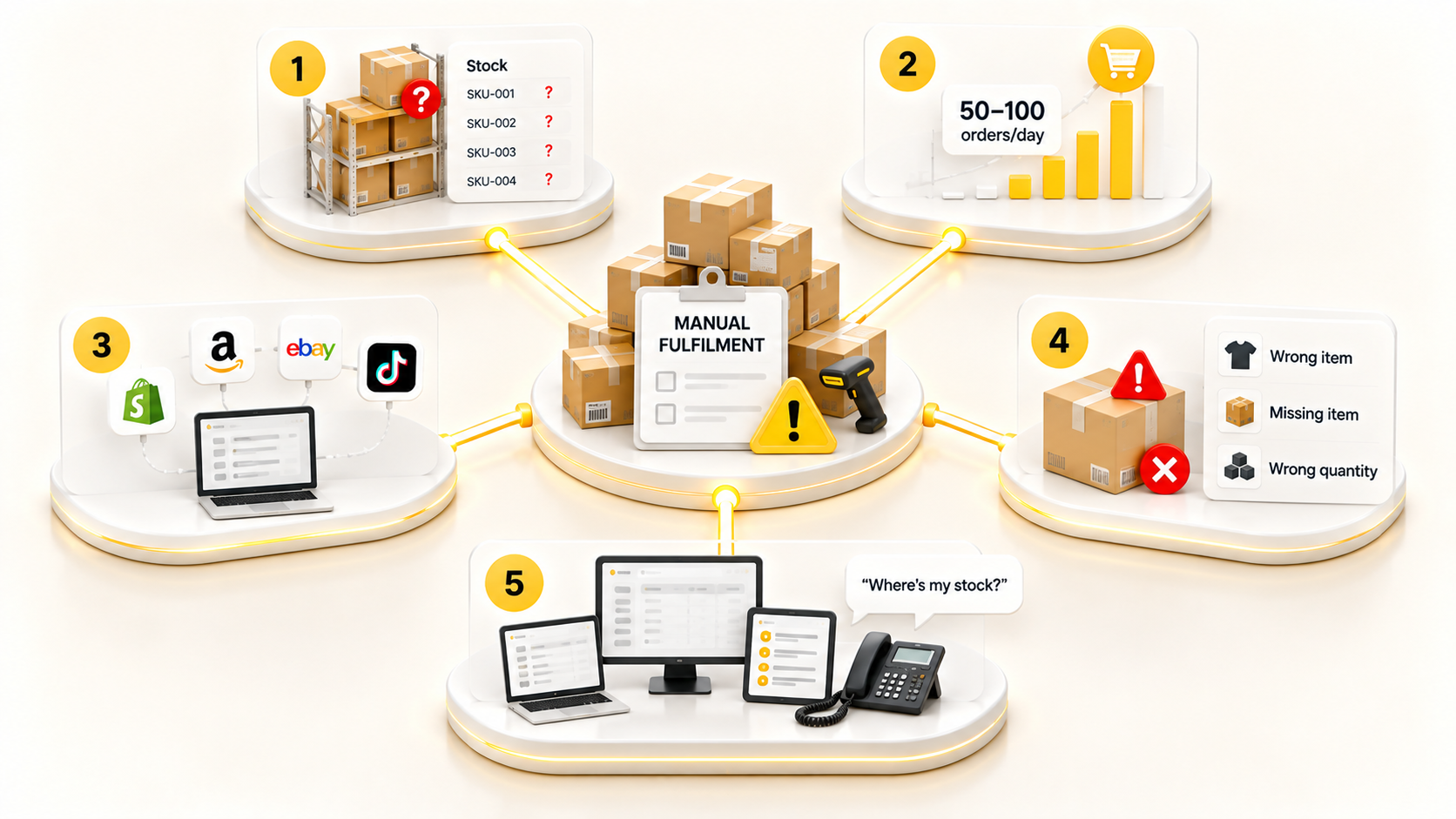
1. Your stock numbers are a guess, not a fact
If your system says 120 units of your best seller and you genuinely don’t know whether that means 118 or 104, you are already paying for a WMS in the form of hidden losses. Studies of small businesses that run on spreadsheets find inventory accuracy often sits between 63 and 83 per cent.
You rarely discover the gap at a convenient time. It appears when a customer’s order needs fulfilling, when a marketplace listing oversells, or when an annual stocktake ties up a whole weekend. A WMS does not stop mistakes from ever happening. It makes them visible the day they happen, while they are still cheap to fix.
2. You are crossing the 50 to 100 orders a day threshold
Ecommerce fulfilment benchmarks put the point where manual systems start breaking at roughly 50 to 100 orders a day. Below that, one or two people can hold the operation together. Above it, memory stops working.
Peak weeks complicate things further, because they can run five to ten times normal demand. You hire temporary staff who need to be productive on their first shift. A pick list that says “find the red one on the shelf” does not work for someone who started this morning. It works even less when three products in the same colour sit next to each other.
3. You sell on more than one channel and trust the same numbers
Your website, Amazon, and eBay all draw from the same stock pool, but they each keep their own count unless something connects them. Every oversold unit costs you margin, a rating, and in the worst case the listing itself.
The giveaway is when you spend your evenings reconciling counts by hand, moving units between marketplaces manually because the numbers disagree. That is double entry dressed up as stock management, and it breaks at exactly the wrong time: during a sale, when stock moves fastest.
4. Wrong orders have become a pattern, not an accident
Fulfilment studies put the average manual picking error rate at 1 to 3 per cent. One wrong parcel in a hundred sounds acceptable until you do the maths. At 200 orders a day, a 2 per cent error rate is four wrong parcels a day, every single day.
Each one costs the reship, the return leg, the customer service time, and often the repeat purchase. Online returns add another layer, with research putting the average ecommerce return rate at roughly one in five orders, far higher in fashion. When picking errors and returns collide, you are not just losing margin. You are funding a second, unpaid warehouse operation for mistakes. We wrote about the fuller cost picture in why your warehouse loses orders.
5. Answering a simple question takes three screens and a phone call
“How many units of X do we hold, where are they, and what have we promised to customers?”
That should be one question with one answer. If it takes a spreadsheet, a marketplace dashboard, and a call to the warehouse, the operation has outgrown its tools, even though the symptoms look like everyday chaos. The hour you spend each morning reconstructing what happened yesterday is the hour a system would give back to you.
The Standalone WMS Trap for Small Sellers
A dedicated WMS is built for distribution centres: hundreds of pickers, wave planning, labour tracking, automation. Those systems have enterprise budgets and are overbuilt for a small ecommerce operation.
The hidden cost is the second database. A standalone WMS does not know what you sold until your store tells it, and your store does not know what you shipped until the WMS tells it back. When that sync breaks, and it always breaks at the worst moment, you are back to reconciling by hand during peak season.
For a small ecommerce business, the cheaper and more durable answer is warehouse functionality inside a platform that also runs your orders, channels, purchasing, and finance. Vision ERP’s WMS module tracks stock by bin location, guides picking on handheld devices, routes orders by stock location, prints courier labels for Evri, Yodel, DPD, and Royal Mail, and sends supplier and dropship orders straight to dispatch without ever touching your warehouse floor. One database, so the stock your website shows is the stock your picker just scanned.
That is the all in one argument in its simplest form, and it is why most small sellers who think they need a standalone WMS actually need something else.
Before You Buy Anything, Do This
Software will not fix an invisible process. Spend two weeks understanding your real numbers first.
Measure: Log every mispick, stockout, and oversell for 14 days. You need your actual error rate, not the one you hope you have.
Fix your product data: Every variant needs a unique SKU and a barcode. This is unglamorous and it is the difference between a WMS that works and one that just stores your old chaos.
Cycle count the 20 per cent: In most operations, one fifth of SKUs drive four fifths of orders. Count those weekly, and let the long tail drift. We covered the mechanics in keeping inventory accurate without manual stock counts.
Standardise receiving: Check every inbound carton against the purchase order before it touches a shelf. Most inventory errors start at the dock, not the pick face.
Do all four and you will know exactly which software features you need, which saves you from buying features you never use.
The Bottom Line
The question was framed as when to buy a WMS. The real question is when the cost of being wrong outweighs the cost of a system.
Most small ecommerce brands are not there yet, and most that are there should not buy standalone. They should buy warehouse capability inside a platform that already knows their orders and their money. If the five signals above feel familiar, that is the moment to have the conversation. Request a Vision ERP demo and see the WMS module running against your own products, channels, and courier labels.