

A percentage tells you how many orders went out wrong. It does not tell you where the process is leaking. This guide covers the picking accuracy metric, the formulas, a target worth aiming at, and the detection loop that finds errors while they are still cheap to fix.
What Picking Accuracy Really Measures
Picking accuracy is the percentage of picks completed without error. A pick is correct when the right item, in the right quantity, from the right location, is assigned to the right order. Fail one check and the pick is wrong, even if the parcel still reaches the customer.
Before calculating, decide what you count:
- Order level. One bad line fails the whole order. Strictest, closest to how customers feel.
- Line level. Each line counts separately. Best view for finding where problems are.
- Unit level. Each unit counts. Most forgiving: one wrong unit in 10 scores 90 per cent.
The same day looks different depending on the unit. Pick one, stay consistent, and say which you are reporting.
Picking Accuracy vs Order Accuracy
People search with both terms, so they are worth separating.
Picking accuracy is measured inside the warehouse at the moment of the pick: did the picker take the right item, in the right quantity, from the right location, for the right order? It is a process score.
Order accuracy is measured at the customer’s door: did exactly what was ordered arrive, complete and undamaged? For multichannel sellers it spans every channel, which is where order management software comes in.
Track both. The gap between them shows whether the problem lives in picking or further down the chain.
Key Warehouse Picking Accuracy KPIs to Track
If you are building an accuracy dashboard, track these four numbers.
| Metric | Formula | What it tells you |
|---|---|---|
| Pick accuracy | Correct picks ÷ total picks × 100 | Picker and process accuracy |
| Order accuracy | Error free orders ÷ total orders × 100 | Customer fulfilment accuracy |
| Picking error rate | Errors ÷ total picks × 1,000 | Error frequency |
| Inventory accuracy | Correct stock records ÷ audited records × 100 | Stock record reliability |
How to Calculate Picking Accuracy
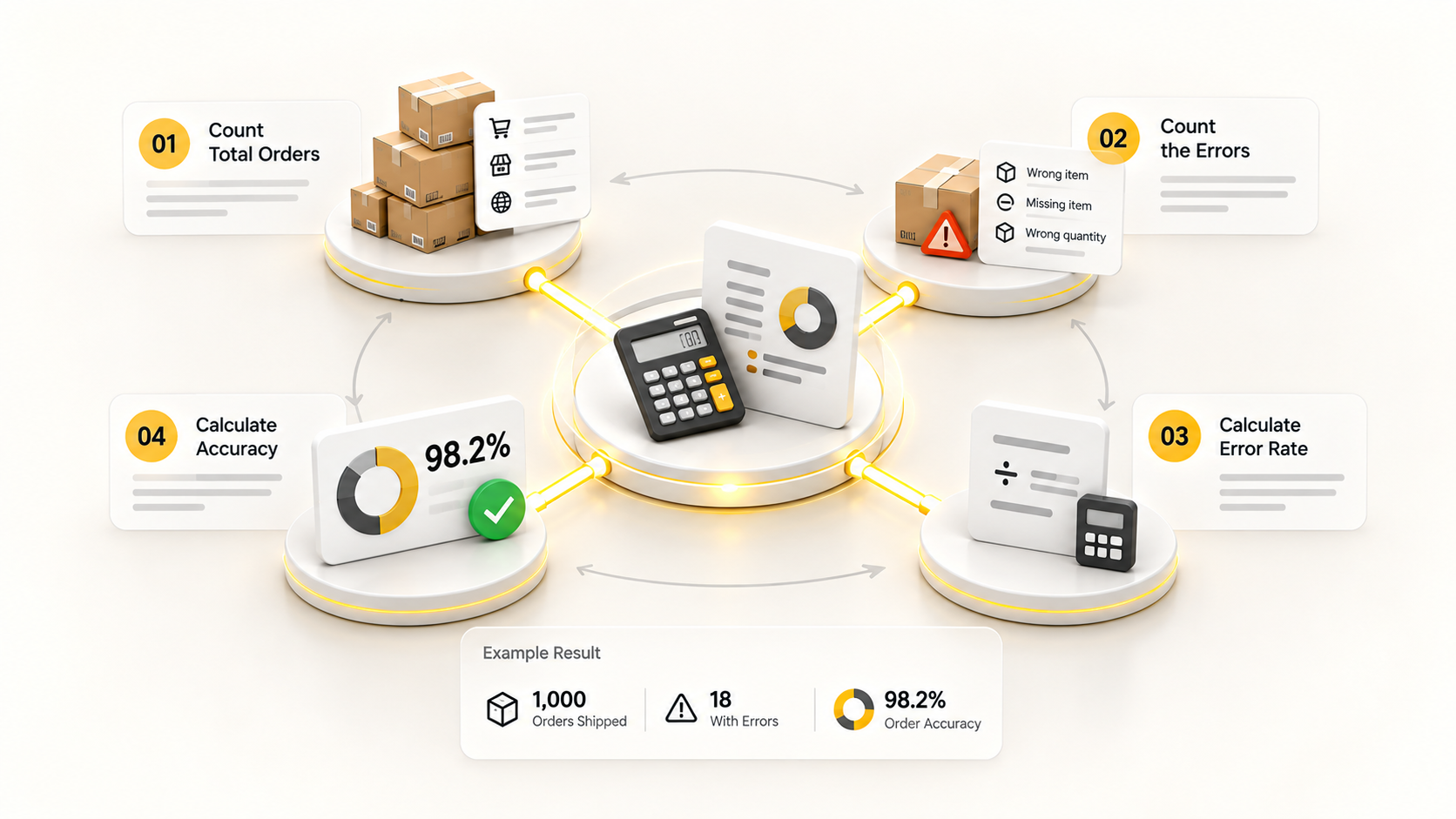
Start with the simplest baseline. It needs no software.
Step 1. Count your total orders. Find the total shipped in a fixed window, one week for example. Count every channel, because they all draw from the same picking process.
Step 2. Count the errors. Track orders with wrong items, missing items, or wrong quantities. Log them wherever they surface: in packing, customer reports, or driver short pick marks on delivery devices.
Step 3. Calculate the error rate. Divide the number of orders with errors by the total number shipped.
Step 4. Calculate accuracy. Subtract the error rate from 100 per cent.
Example: you ship 1,000 orders in a week and 18 contain picking related errors. Your order error rate is 1.8 per cent, giving an error free order rate of 98.2 per cent. Note what this is: order accuracy, not pick accuracy, because you counted whole orders.
For picking accuracy itself, measure lines or units picked rather than orders:
Pick accuracy = (error free picks ÷ total picks) x 100
Many operations also track errors per 1,000 picks because it stays readable as volumes grow:
Error rate = (total errors ÷ total picks) x 1,000
Log daily totals in a spreadsheet, then review by week and month. The daily figure bounces; the weekly trend tells you whether anything is improving.
What Is a Good Picking Accuracy Target?

Three practices keep accuracy high:
Aim for 98 per cent: Many successful warehouses use 98 per cent as the working standard; best in class reaches 99.5 per cent or better. Agree on your unit first, because 98 per cent at order level differs from the same target at unit level.
Review weekly: Errors climbing in one zone, product group, or shift is a signal. Weekly review catches drift before peak volumes multiply it.
Coach and reward: Share the numbers. Reward people who beat the goal and train those who fall below it. Recording an error must carry no penalty, or the data will quietly lie to you.
The “good enough” trap applies too. 98.5 per cent at 4,000 lines a day is 60 wrong lines today and thousands a year, each carrying rework and a customer who noticed. Thats how warehouses lose orders: the causes hide behind a number that looks healthy.
How to Identify and Trace Picking Errors
Tracking accuracy is a loop. Run all four steps weekly.
Detect: An error can only be counted where it is found, and most are found downstream: in packing, pre dispatch checks, driver short pick marks, returns, and complaints.
Attribute: This is where most warehouses leak. Packing finds an error, fixes it, and nobody records that a picking mistake happened. Returns get logged as returns, not as picking failures, so the number says 99 per cent while the floor knows it is closer to 97. Attribution means every error, wherever found, is recorded against the picking stage where it started.
Log: Keep the record simple: date, order number, SKU, quantity expected versus picked, bin location, error type, detection stage, picker or shift. Keep the picker field neutral; this is pattern analysis, not blame. Five buckets cover most operations: wrong item, wrong quantity, missed line, wrong location, and label mismatch. Fix the top two error types first.
Analyse stock and returns: The returns desk is a free accuracy audit you already pay for: a returned “wrong item” often traces to picking. Then watch stock. Some failures never reach returns, like the corrected wrong location pick, where stock sits in the wrong bin, gets scanned anyway, and the order ships while the shelf stays wrong. Only inventory accuracy tracking and cycle counts reveal this. Track both, or you will be scoring a process that is quietly coming apart.
How Technology Improves Picking Accuracy
Prevention beats detection. In order of control:
Barcode scanning: The baseline for most growing warehouses. At putaway, scanning confirms the item lands in the right location. At the pick, when integrated with a Warehouse Management System (WMS), scanning can validate item and location against the order while the system records the quantity picked. Every scan creates a record of who, what, when, and where.
Pick to voice and pick to light: Spoken instructions or a shelf light remove reading and keying errors, and every confirmed pick is logged.
WMS directed picking: The system decides what to pick, in what sequence, and from which bin, validating each step in real time. The only option that both prevents errors and builds the full picture automatically, which is the main reason the WMS or ERP question keeps coming up.
Add spot checks: Have a checker review a sample before dispatch, especially long distance and high value orders. If the sample shows errors the pick count missed, attribution is still leaking.
Turn Picking Accuracy Data Into Warehouse Control
Paper depends on people noticing and recording errors. Software removes that ceiling: it validates every pick, tracks bins not just products, updates stock in real time, and reports accuracy automatically.
One warning: when a measure becomes a target it stops being a good measure. Show only picks per hour and the team trades accuracy for speed. Track both.
This is what Vision ERP and its warehouse management system are built for: barcode driven workflows, bin level tracking, and reporting leadership can read directly.
Make Accuracy Visible Before It Costs You
Choose your unit, calculate the baseline, set a target, and run the detection loop until your system does it for you.
Talk to Sapio Systems about how Vision ERP tracks picking accuracy in real time. Or start with the error log this week: the first week of honest data will tell you more than the last annual report did.