
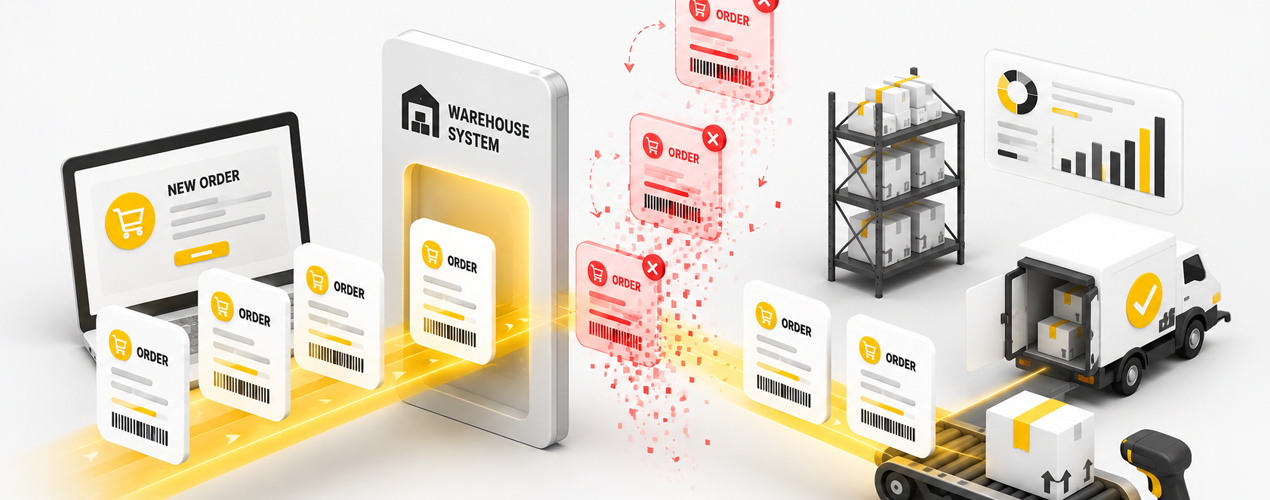
Every lost order costs you more than the product itself. You lose the revenue, the customer’s trust, and the operational hours you spent picking, packing, and preparing that shipment. Multiply that over weeks and months, and the damage adds up fast.
If you run a warehouse, distribution centre, or fulfilment operation, you have likely felt this frustration. Orders go missing. Inventory counts don’t line up. Shipments arrive delayed or wrong. And most warehouse managers don’t realise how bad it is until the complaints pile up.
This blog breaks down the real reasons your warehouse is losing orders and the practical steps you can take to fix them. If you are looking for a technology partner to help you solve this for good, Sapio Systems offers Vision ERP, a warehouse and distribution management platform built to eliminate the exact issues described here.
The True Cost of Lost Orders
Lost orders are not just a line item on an error report. They ripple through your entire business.
Revenue loss – Every lost order is a sale you either lose or have to refund. Even a small percentage of lost orders eats into profitability significantly.
Customer churn – A single poor fulfilment experience can turn a loyal buyer into someone who never returns.
Operational waste – When an order is lost, you also lose the labour, packing materials, shipping costs, and time spent investigating what went wrong.
Reputation damage – In B2B and wholesale environments, reliability is everything. Customers who can’t trust you will find a competitor who can.
How to Know If Your Warehouse Has a System Problem
Not every lost order is a sign of a systemic issue. One wrong pick, one late shipment, one inventory error happens to every warehouse. The real question is whether these incidents are isolated or part of a pattern.
Here are six signs that point to a system level problem.
➟ Same mistakes, different people – When multiple team members are making the same error, the issue is not the person. It is the process, the tool, or the layout that’s causing it. A well designed system should make it hard to make mistakes, not easy.
➟ Error rate trending upward – Training and corrections are not fixing the problem. When your error rate keeps climbing over time, something in your system is failing. It could be outdated inventory data, poor communication between systems, or a layout that confuses your team.
➟ Firefighting instead of fulfilling – Your warehouse staff are constantly backtracking, correcting mistakes, and dealing with problems instead of picking orders. The system is not working. A well run warehouse should have a steady flow from receiving to shipping with minimal interruptions.
➟ Inventory counts never match – When you do a full count and find discrepancies, but the next month the numbers are off again, the problem is not the count. It is the process that is supposed to keep inventory accurate between counts.
➟ Problems showing up everywhere – When picking errors are happening in Zone A and Zone B, and receiving errors are happening at the same time, the issue is not localised. It is a system wide failure that’s affecting multiple processes.
➟ Staff can’t find what they’re looking for – When your team can’t locate products on the shelf, it is not a memory problem. It is a layout problem, a labelling problem, or a system problem that’s not telling them where things are.
Ask your team directly. What is slowing them down? What is frustrating? What makes their job harder than it should be? Your team sees the problems every day. They know where the system is failing. They just need someone to listen.
A single lost order is a mistake. A pattern of lost orders is a system failure. The sooner you identify it, the sooner you can fix it.
7 Reasons Your Warehouse Is Losing Orders
Not all order losses are dramatic. Many are quiet, gradual problems that build up over time. Here are the root causes you should not ignore.
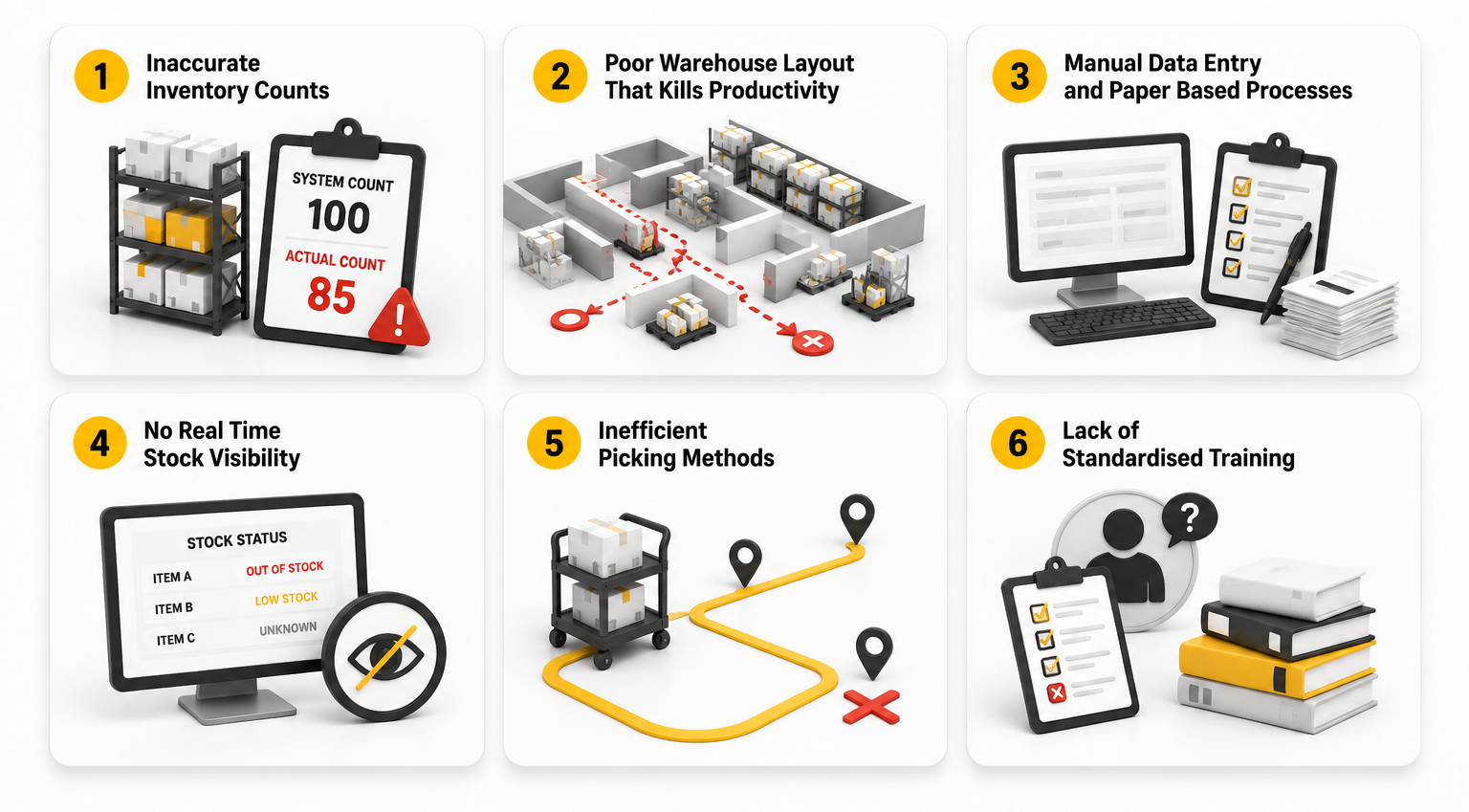
1. Disconnected Systems
When your inventory management system doesn’t sync with your order management system, orders slip through the cracks. Many warehouses still rely on spreadsheets, legacy software, or a patchwork of tools that don’t communicate with each other. Every time information has to be manually transferred between systems, you introduce the possibility of human error.
A team member might enter the wrong SKU. A batch transfer might fail silently. An order might sit in a queue that nobody checks. The result is a fragmented operation where data is scattered and errors are inevitable.
2. Wasted Travel Time
Your warehouse team spends a large portion of their day just walking. When layout and system guidance are lacking, staff wander between locations instead of picking efficiently. Storing high-demand items in the wrong spot or having no optimised picking route means slower fulfilment and more errors at the end of the shift.
Studies have shown that order picking can account for up to 55% of total warehouse operating costs, and a significant portion of that time is spent walking between locations rather than actually picking items.
3. Inaccurate Inventory Data
If your system says you have 200 units but you can only find 185, you are working with wrong information. Inaccurate inventory data builds up gradually. A return doesn’t get logged. A shipment arrives short but isn’t recorded. Over time, the gap between what the system thinks is on the shelf and what is actually there grows wider.
When a customer orders a product your system shows as available but the stock isn’t there, you are left with cancelling the order or delaying fulfilment. Either way, the customer experience suffers.
4. No Real-Time Visibility
Without real-time visibility into order status, inventory levels, and warehouse activity, you cannot proactively prevent problems. You can only react after damage is done. If your system updates in batches, you are always working with outdated information. And outdated information leads to bad decisions and missed orders.
You don’t know an order has been sitting in the picking queue for two hours. You don’t know a product has gone out of stock until a customer places an order for it. You don’t know a shipment is delayed until the customer calls to complain.
5. Disorganised Layout
When your warehouse is disorganised, everything takes longer. Finding products takes longer. Walking between locations takes longer. If similar products are stored close together, picking errors increase. If high-demand items are stored in the back, travel time increases.
Think about the flow of goods through your warehouse. Where do incoming shipments arrive? Where are they stored? Where does picking happen? Where is packing done? If these questions don’t follow a logical flow from receiving to shipping, your layout is working against you.
6. Manual Data Entry and Paperwork
Every minute your team spends writing down data on paper is a minute that could be spent picking orders or improving efficiency. Manual data entry creates typos. Paper orders can get lost, damaged, or mixed up. Paper cannot be tracked or verified automatically.
This forces your team to rely on visual inspection and memory, both of which are unreliable. Moving to digital workflows eliminates manual paperwork, speeds up operations, and makes it possible to maintain accurate records.
7. Receiving Errors
Receiving is where order fulfilment begins. If your team makes errors during receiving, those errors carry through the entire operation. A wrong quantity received leads to inaccurate inventory. A mislabelled product gets stored in the wrong location. A missing item goes unnoticed until it is needed for an order.
Without a structured process for checking inbound shipments against purchase orders, you won’t discover discrepancies until much later. By the time you realise a shipment was short, the product may already be on the shelf with an incorrect count.
How to Fix Warehouse Order Loss Fast
Now that you understand the root causes, let’s talk about the specific steps you can take to fix them.
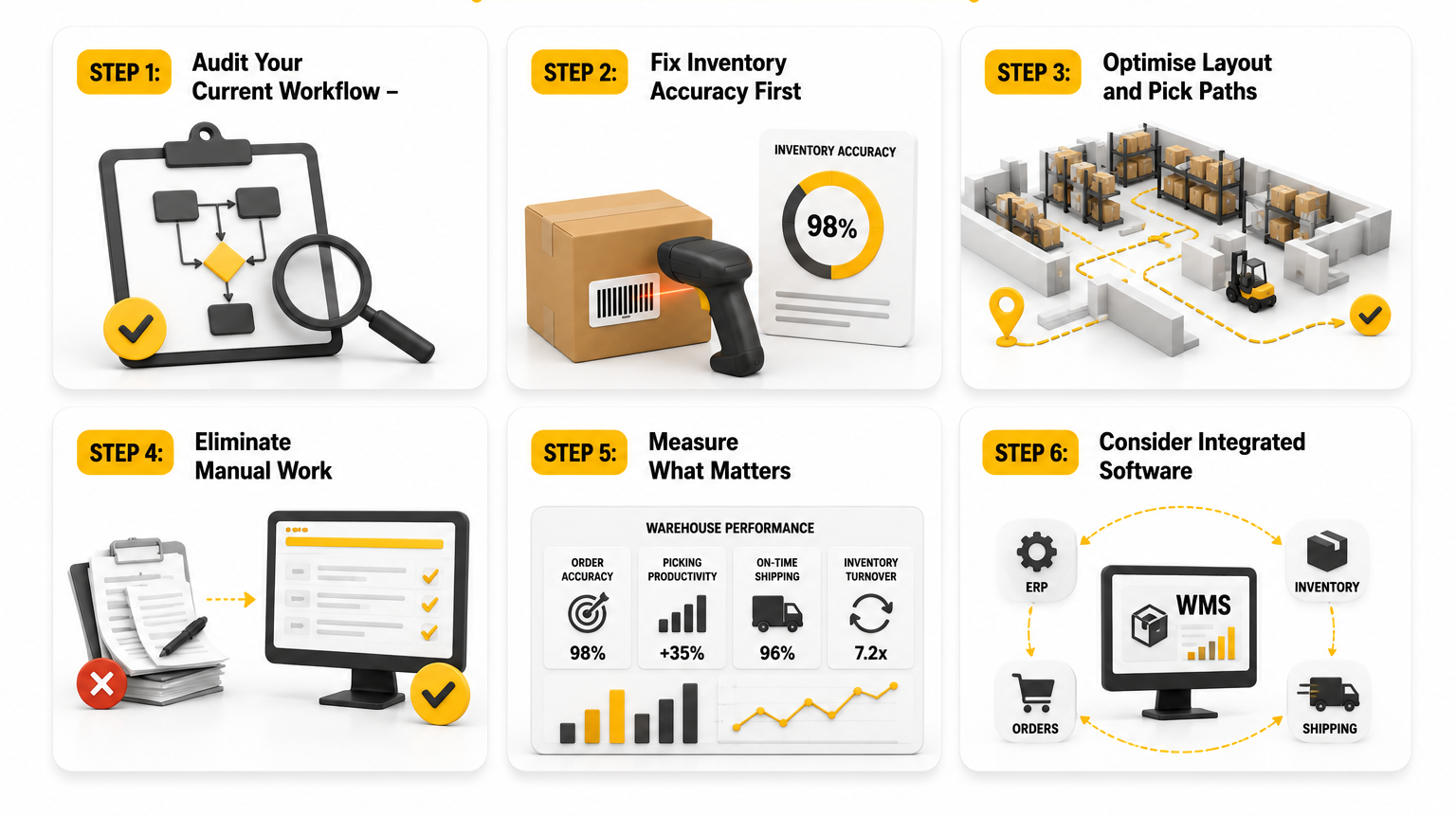
1. Digitise and Unify Your Systems
The single most impact change you can make is to move to a unified digital system. When everything is in one place, you eliminate gaps between tools and create a single source of truth. No more spreadsheets, no more manual data transfer, no more disconnected tools.
Organisations typically begin by integrating inventory, purchasing, and sales into a single platform because these departments create the largest volume of data inconsistencies. Once synchronised, barcode scanning and warehouse automation become significantly more effective.
2. Optimise Your Warehouse Layout
Analyse your order data and arrange storage based on product demand, size, and picking frequency. High-demand items should be in accessible locations. Similar products should be grouped together. There should be a logical flow from receiving to storage to picking to packing to shipping.
Many businesses redesign their warehouse around product categories instead of order frequency. Six months later, travel time increases because fast moving products have shifted while the layout stays the same. Reviewing slotting based on recent demand patterns often produces better results than relying on the original design.
3. Integrate Scanners and Barcodes
Barcode scanning is one of the simplest and most effective ways to reduce errors. When your team scans items instead of typing codes, the chance of error drops dramatically. Scanners verify the correct item, confirm quantities, and confirm that the right order is being shipped.
Many warehouses install barcode scanners but continue to experience inventory discrepancies because employees can bypass scans during peak periods. The technology only improves accuracy when every inventory movement becomes a mandatory system event rather than an optional step.
4. Group Your Orders
Group orders by similar products, delivery area, or priority level. This reduces the number of trips your team makes through the warehouse. If three orders require the same product, pick them in one trip instead of three.
Grouping also helps with prioritisation. High-priority orders can be processed first. Orders going to the same region can be grouped together to simplify shipping. This saves time, reduces travel distance, and minimises mispicks.
5. Deploy Digital Workflows
Paper-based processes are slow, error-prone, and difficult to track. Digital workflows replace paper with electronic systems that guide your team through every step. An order comes in, a pick list is generated and assigned, items are picked and scanned, the order moves to packing, and shipping details are confirmed. At every stage, the system tracks progress.
Digital workflows eliminate manual paperwork, reduce errors from miscommunication, and provide real-time visibility into every order’s status. Your team knows exactly what to do, when to do it, and where to go next.
6. Utilise Batch and Zone Picking
Batch picking means picking multiple orders at the same time instead of one order per trip. This reduces travel distance and speeds up the overall process.
Zone picking means dividing the warehouse into zones and assigning team members to specific areas. Each person picks items only from their zone, then orders are consolidated and sent to packing. This reduces the time spent crossing the entire warehouse for every order.
Both strategies reduce travel time, increase picking speed, and lower error rates.
Stop Losing Orders. Start Growing.
Every order you lose is a customer you disappoint and revenue you leave on the table. The good news is that the fix doesn’t have to be complicated. The right technology, combined with the right processes, can eliminate the root causes of lost orders and put your warehouse on a path to consistent, reliable fulfilment.
If you are ready to take control of your warehouse operations, Sapio Systems is here to help. Vision ERP gives you the visibility, control, and efficiency you need to stop losing orders and start delivering on every promise you make to your customers.
Contact Sapio Systems today to learn how Vision ERP can transform your warehouse operations.