
Business owners often ask the same question when they start researching enterprise resource planning systems: how long will this take? The answer is rarely simple.
Implementation timelines vary wildly depending on company size, system complexity, data readiness, and internal commitment. Some projects wrap up in three months. Others drag on for two years.
| Business Type | Typical ERP Timeline |
| Small distributor with clean data | 3 to 4 months |
| Multi warehouse distributor | 6 to 9 months |
| Manufacturer with custom workflows | 9 to 12 months |
| Enterprise with legacy integrations | 12+ months |
In most cases, implementation speed depends less on the software itself and more on operational complexity, data quality, internal decision making, and how much customisation is required.
For example, a small distributor with standardised workflows and clean inventory data may complete deployment within 90 to 120 days. A manufacturer with multiple warehouses, custom procurement rules, and legacy integrations may require 9 to 18 months.
The Implementation Lifecycle Phases
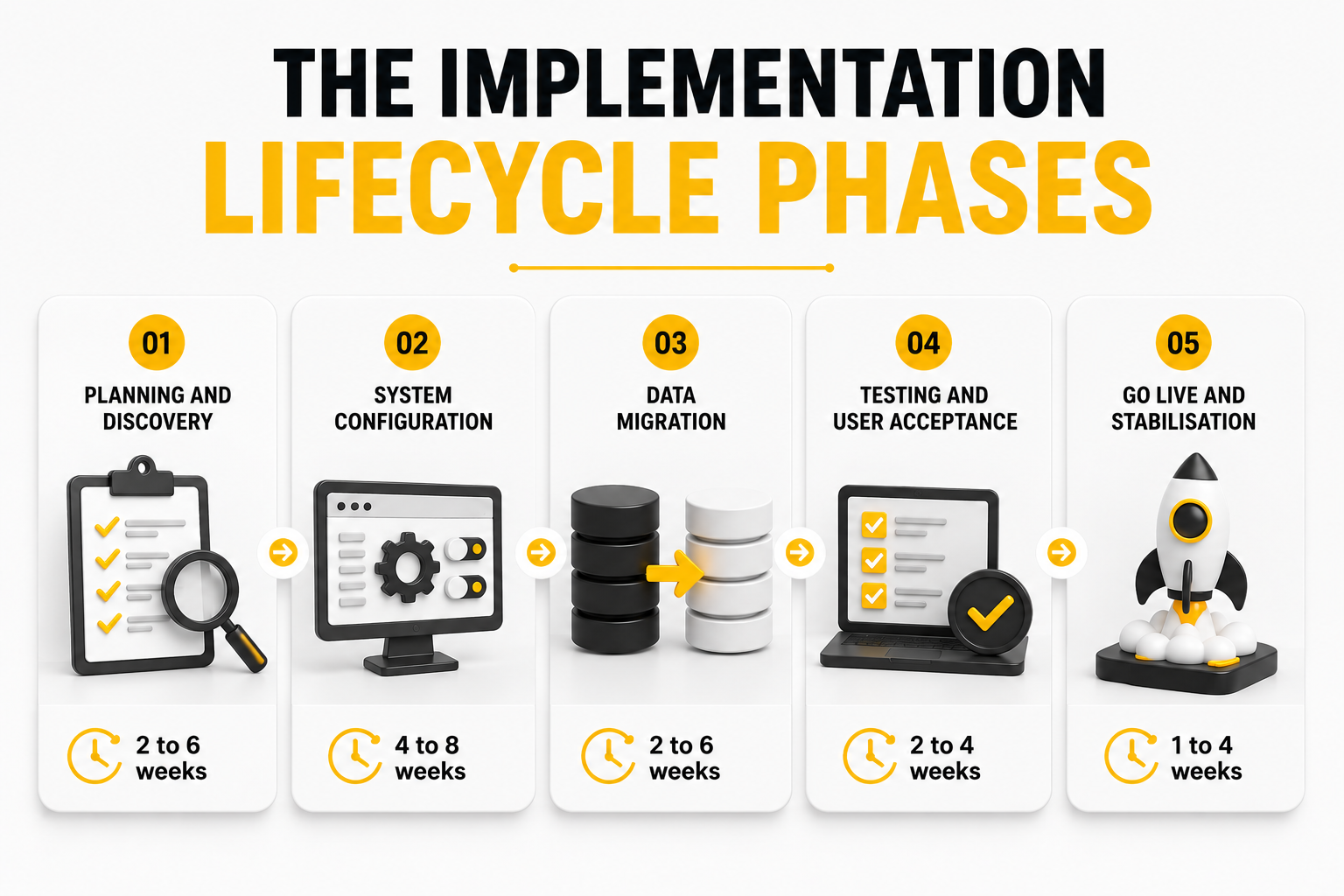
Every ERP roll out follows a structured life cycle. Understanding each phase and its typical duration helps you build a realistic schedule and allocate resources properly. Below is a breakdown of each phase with the expected time range and what happens during that period.
➟ Planning and Discovery (2 to 6 weeks)
This phase involves mapping your current workflows, identifying pain points, defining reporting requirements, and setting clear success metrics. The team must also decide on data migration scope, integration points, and user roles.
Many businesses discover during this phase that departments have been using undocumented processes for years. Warehouse teams, purchasing staff, and finance departments often follow different operational rules that must be standardised before implementation can move forward efficiently.
➟ System Configuration (4 to 8 weeks)
During this period the system is set up to match your operational rules. For Vision ERP, configuration focuses on business logic such as pricing tiers, order workflows, warehouse zones, and user permissions.
The platform already includes the modules most distribution and manufacturing companies need, so there is no need to build core functionality from scratch. This approach compresses the configuration timeline significantly compared to generic ERP systems.
➟ Data Migration (2 to 6 weeks)
Historical transactions, item masters, customer accounts, vendor records, and open orders must be extracted, cleaned, transformed, and loaded into the new system. A full test migration followed by validation is essential to catch errors before going live.
One of the most common migration issues involves duplicate inventory records, inactive customer accounts, inconsistent SKU naming conventions, and missing supplier information. Cleaning this data before implementation begins can significantly reduce delays during testing and go live preparation.
➟ Testing and User Acceptance (2 to 4 weeks)
Power users and department leads run real world scenarios to confirm that the system behaves as expected. Management reviews reports and dashboards. Adjustments are made based on feedback.
Running parallel testing with live data from the old system reveals any gaps in functionality or data integrity. Vision ERP includes a sandbox environment that allows unlimited testing without affecting live operations.
➟ Go Live and Stabilisation (1 to 4 weeks)
The old system is shut down, the new system becomes the source of truth, and a dedicated support team handles questions and unexpected issues.
Hyper care support during this window is critical for building user confidence and minimising disruption to daily operations. Vision ERP implementations include a structured stabilisation period where the Sapio Systems team provides direct assistance to end users.
The 4 Major Factors That Really Drive the Timeline
Four critical factors separate fast implementations from slow ones. Recognising them early helps you make decisions that keep the project on track.
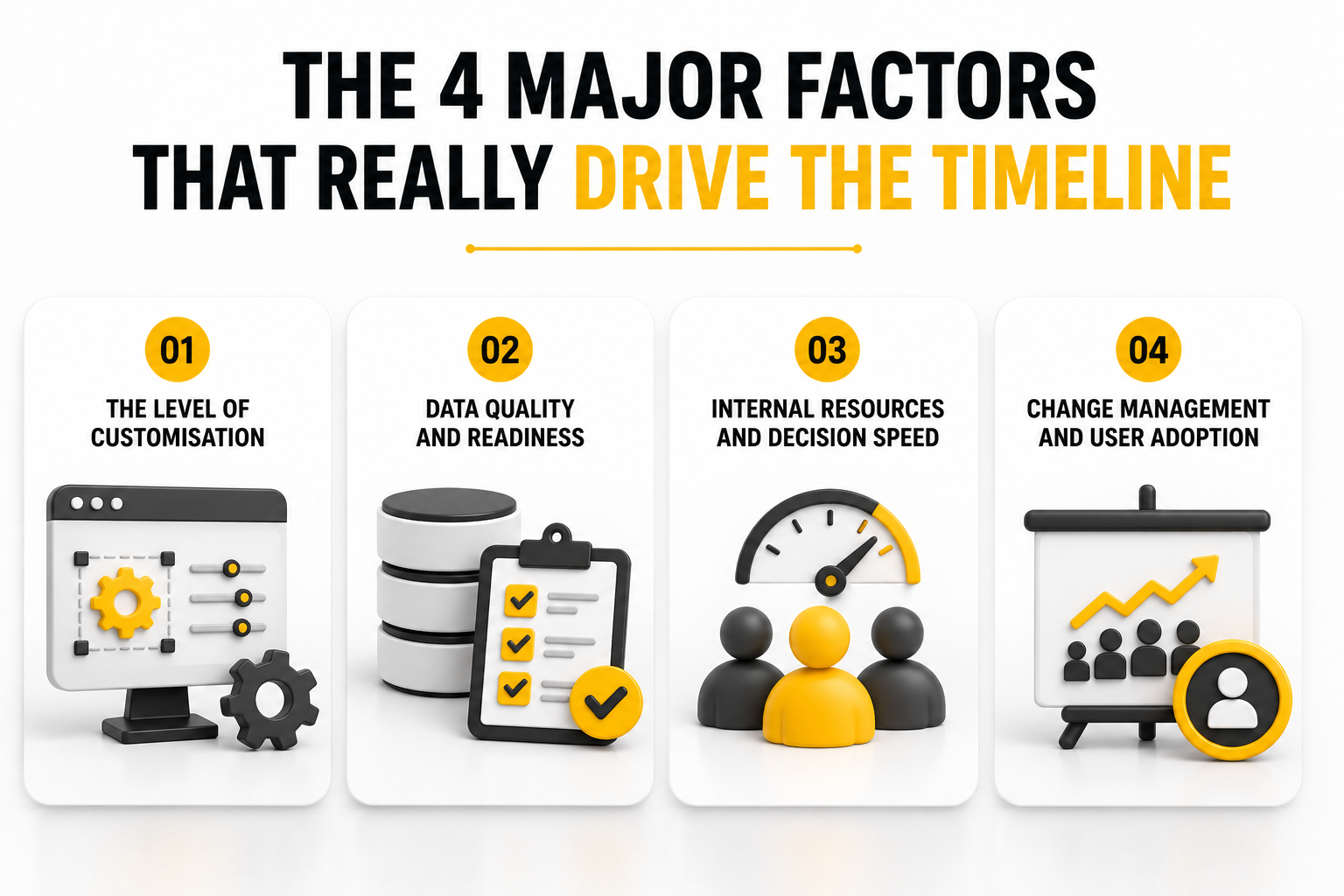
1. The Level of Customisation
Traditional ERP systems require months of custom development to replicate legacy workflows. Every custom report, modified screen, or unique integration adds development time and testing cycles.
Vision ERP eliminates this drag because it was built by experienced business operators who understood that a pre configured system for distribution and manufacturing removes the need for heavy customisation. The more the system matches your industry standards out of the box, the shorter the timeline.
2. Data Quality and Readiness
This factor is often underestimated. When your legacy data contains duplicate records, inconsistent naming conventions, or incomplete transactions, the migration team must spend extra time cleaning and standardising information before it can be loaded.
A thorough data audit before the project starts can reduce the migration phase by several weeks. Companies that invest in data hygiene early always move faster.
3. Internal Resources and Decision Speed
ERP implementation is not something you can delegate entirely to an external partner. Your team must review configurations, make decisions about workflows, and test the system thoroughly.
When internal decision makers are slow to approve changes or when key users are pulled away for other projects, the timeline slows down. Appointing a dedicated project manager with authority to make decisions and clearing calendar time for the core team are essential steps.
4. Change Management and User Adoption
Resistance from employees who are comfortable with the old system can create hidden delays. If users enter data incorrectly or resist new processes, the system produces unreliable information that requires cleanup and rework.
Early training, transparent communication, and involving end users in the testing phase reduce resistance and keep the implementation moving. Vision ERP includes a built in training environment and role based user guides that accelerate adoption.
Why Vision ERP Speeds Up the Process
ERP implementation speed improves when businesses reduce unnecessary customisation, prepare data early, and adopt workflows aligned with industry best practices.
Vision ERP from Sapio Systems was designed specifically for distribution and manufacturing environments, which helps reduce the need for extensive redevelopment during deployment.
For distribution and manufacturing businesses seeking a more predictable implementation process, Vision ERP provides a structured operational foundation designed to reduce deployment complexity and accelerate user adoption.