
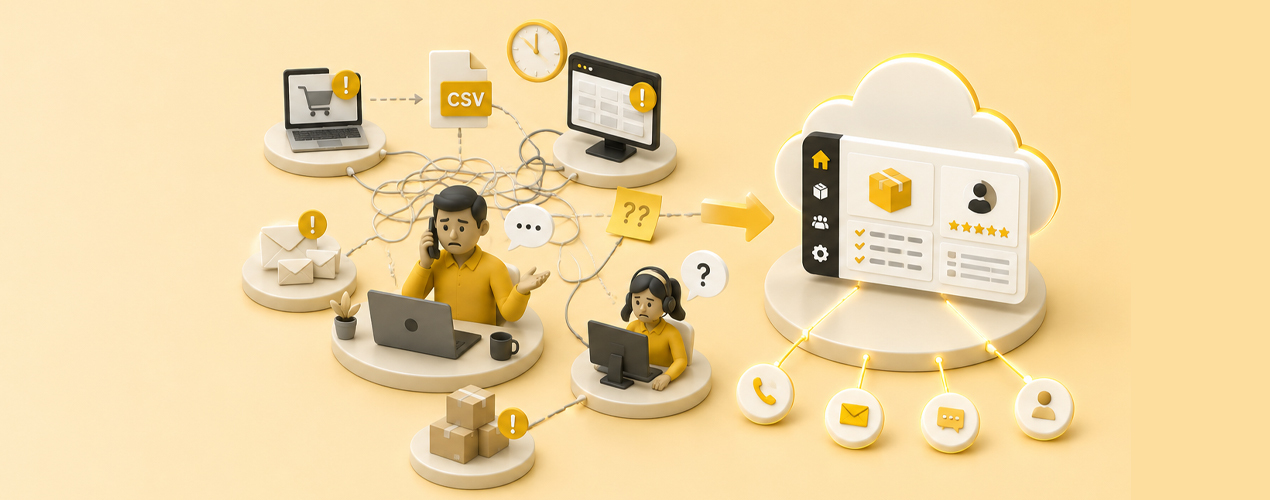
Every business that sells products across multiple channels has felt the moment when customer service starts to slip.
The phone rings more often. Emails pile up. Customers repeat the same complaints about late deliveries, wrong items, or missing information. The team works harder, but the issues keep coming.
This pattern is not the fault of the agents or the customers. It is a hidden problem in the system that manages orders. When order data is scattered, customer service cannot operate smoothly. Agents spend more time searching for information than solving problems.
The solution is a central order system, often called an Order Management System or OMS, that unites every piece of order information in one place.
Five Signs Your Order System Is Hurting Customer Service
Before exploring the root causes, it helps to recognise the symptoms. Many businesses normalise these issues and treat them as inevitable parts of growth. They are not.
Your agents answer “Where is my order?” ten times a day – If customer service reps spend significant time on order tracking enquiries rather than resolving complex issues, the root cause is usually a lack of real time inventory visibility. An integrated OMS with customer facing order tracking eliminates the need for these calls.
Returns trigger a chain of errors – When a customer initiates a return through one channel but the warehouse does not update stock levels, the system may oversell the same item. This happens because returns management is not synchronised with inventory data.
Agents pull information from three or more screens to answer one question – If your team needs to open a separate CRM, check a warehouse management system, and reference a spreadsheet to resolve a single query, you are experiencing the fragmentation that kills service speed. None of these tools hold the complete picture.
Marketplace orders arrive without matching shipping data – When sales come through a marketplace like Amazon or eBay, the order details must sync with your warehouse and shipping carrier integration. If they do not, the warehouse ships based on outdated information.
New channels create more chaos than revenue – Each new platform introduces its own data format and order flow. The team spends more time reconciling data than fulfilling orders. A system with robust API integrations allows new channels to connect without disrupting existing operations.
If you recognise two or more of these signs, your business is not dealing with a customer service problem. You are dealing with an order data problem.
Here is a breakdown of why service breaks without a unified system and how to address it.

The Fragmented Order Lifecycle
Retail operations involve multiple moving parts. A customer might place an order through a website, then another through a marketplace, then a third through a live sales event. Inside the business, warehouse staff pick and pack using a WMS, dispatch teams ship, and finance teams process payments. Without a central system, each department sees only a piece of the puzzle.
Inventory data lives in one place, order details in another, customer history in a third. When an agent needs to answer a question about a backordered item or a partial shipment, they have to piece together information from different silos.
Order orchestration becomes nearly impossible when every channel operates independently. Multi channel retail demands that orders flow from the point of sale to the warehouse to the customer without manual intervention. Omnichannel fulfilment depends on a single source of truth for inventory, shipping, and customer communication. When that source does not exist, customers experience inconsistencies that erode trust.
The Real Cost of Disconnected Systems
The consequences go beyond long hold times. When orders are scattered across separate tools, mistakes multiply.
A customer changes their shipping address through one channel, but the warehouse ships to the old address because the update did not sync. A return is processed in one system but not reflected in inventory, leading to overselling. An agent promises a refund that does not reach the bank because the payment gateway and the order system do not talk to each other.
Each error adds to the workload. Customer service teams spend time investigating, apologising, and issuing goodwill credits. The business absorbs the cost of extra shipments, lost products, and administrative overhead. Meanwhile, customers become more cautious. They start checking their accounts repeatedly, calling to confirm, asking for proof of delivery.
Purchase orders placed based on outdated stock levels lead to overstocking or under-stocking. Stock allocation errors mean popular items sit unavailable while slow movers gather dust. Backorders that are not flagged or communicated properly lead to cancellations and negative reviews.
Why Manual Workarounds Fail
Some businesses try to bridge the gaps between systems with spreadsheets, manual data entry, or late night reconciliation tasks. These workarounds are fragile and temporary. A spreadsheet can be overwritten. A person can forget to update a status. A shift change can introduce inconsistencies.
Manual reconciliation also slows everything down. When a customer asks “When will my item ship?”, the agent cannot answer immediately. They have to check the warehouse system, cross reference the order, then call back. That delay feels much longer to a customer who expects instant answers.
People overestimate the length of a wait when the outcome is uncertain. A thirty second hold feels like minutes if the agent does not have the answer. Speed and certainty are emotional needs, not just operational metrics.
Automation is the key to eliminating manual reconciliation. When order status updates, inventory changes, and shipping confirmations flow automatically through a single system, the human team can focus on what humans do best. Barcode scanning at the warehouse, real time inventory updates, and automated purchase order generation all depend on a unified data layer.
Customer Service as a Business Driver
When customer service runs smoothly, it stops being a cost centre and starts generating repeat business. Customers who get quick, accurate answers are more likely to buy again and to recommend the brand.
A central order system reduces the number of inbound queries because customers can see their order status clearly, and because the first person they speak to can resolve the issue without hand-offs.
A well integrated CRM connected to the OMS gives customer service agents a complete view of every interaction. They can see previous orders, complaints, returns, and customer preferences in one place. This context transforms a transactional conversation into a relationship building opportunity.
Choosing the Right Foundation
A central order system is not just software. It is the operational backbone that connects sales, fulfilment, and support. For businesses in the UK that manage retail and shipping, the system must be fast, scalable, and mobile capable. Managers need to check orders on the move. Warehouse staff need to scan barcodes from handheld devices. Agents need to answer calls from anywhere.
An ERP platform designed around order management provides this foundation. When the system includes built in modules for customer service, warehouse management, and marketplace integration, the entire operation aligns around one data set.
The right system integrates with your shipping carriers, accounting software, CRM, and sales platforms through API integrations that keep data flowing in real time. It handles order tracking, returns management, stock allocation, and purchase order generation without requiring separate tools for each function.
Scalability and the Growing Business
For a small business with a handful of orders per day, manual processes can work. But as volume increases, the cracks widen. Doubling the order count does not simply double the problems. It multiplies them because the number of hand-offs and data exchanges grows exponentially.
A central system scales without friction. New sales channels can be added through APIs. New warehouse locations can be integrated. Customer service capacity can expand without retraining on new tools.
Real time inventory visibility is critical at scale. When a product is low in stock across one channel, the system can automatically adjust availability across all channels. When a backorder is placed, the system can notify the customer and generate a purchase order for restocking.
The Shift from Reactive to Proactive
Businesses that move to a central order system notice a shift. Customer service teams spend less time firefighting and more time building relationships. They can identify patterns, spot recurring issues, and work with operations to fix root causes.
Inventory problems become visible before they affect customers. Shipping delays are flagged early. With order orchestration handled by the system, the business can automate follow ups, send delivery updates, and alert customers about potential delays before they happen.
This proactive capability changes how customers perceive the brand. They no longer see a company that reacts slowly to problems. They see a company that anticipates their needs and solves issues before they arise.
Conclusion
Customer service does not break because of bad people or even bad processes. It breaks because the data that drives service is scattered. Every disconnected tool creates a gap where information gets lost, delayed, or corrupted. Those gaps become the source of customer frustration and operational inefficiency.
A central order system closes those gaps. It creates a single source of truth that every department can rely on. Customer service agents see the full story. Warehouse teams know what to pick. Finance teams know what to reconcile. The entire business moves with the same real time data.
Contact our team to see how a unified order system can transform your customer service operations and turn every customer interaction into an opportunity for growth.