
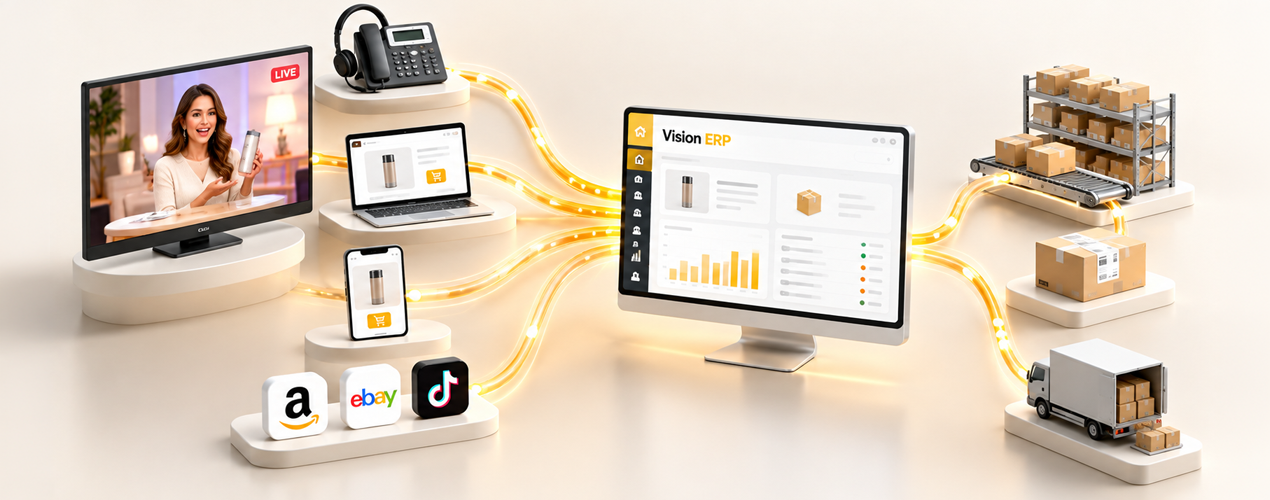
When a presenter holds up a product on a TV shopping channel, the next few minutes decide whether the slot makes money. Orders arrive by phone, through the website and from the app at the same time, often hundreds in a single segment. Each one has to be captured, paid for, checked and dispatched while the show keeps running.
Here is the part most operators miss. TV shopping sales are rarely lost at the moment a viewer decides to buy. They are lost in the processing steps that follow. A call drops, a payment fails, or stock runs out on screen. A parcel leaves late.
This article walks through how a broadcast retail order moves from screen to doorstep. It also shows where a channel leaks revenue without noticing. If you want the platform side first, read the earlier guide to TV shopping software. It covers what the technology is and why broadcast retail strains ordinary systems.
How a TV Shopping Order Moves From Screen to Doorstep
Every order on a shopping channel passes through the same chain, whether the customer called in or checked out online. Six steps decide whether the sale survives. Speed matters at every one of them, because a live show does not wait for a spreadsheet.
1. Order capture
The order enters the system through one of several doors. A call centre agent takes the card details while the caller is still watching. The website checkout records the sale. The app pushes the same product, and a marketplace listing adds another stream. Every door has to write to the same order pool. The phone sale and the web sale are then treated as one customer and one stock record. That shared pool is what omnichannel retail ERP software is built to provide.
2. Payment and fraud check
The transaction is authorised and checked before the parcel moves. Phone payments need the same security as online checkout, and instalment plans have to be recorded the way they actually run. A declined card or a failed verification kills a surprising share of TV orders. The viewer has usually moved on by the time anyone notices.
3. Stock reservation
The moment payment is accepted, the units leave sellable stock. The presenter’s screen, the website and the warehouse all read the same number. The on air count stays honest, and the channel never shows more product than it can ship. Orders that fail payment put the units straight back into the pool, ready to be reoffered before the show ends.
4. Allocation and routing
The system decides which stock source fulfils the order. Some channels ship from their own warehouse. Others send the order straight to a third party supplier. Allocation rules carry the business judgement, reserving part of a batch for web orders, part for broadcast and part for customer replacements. Without these rules, the fastest seller on air is also the fastest one to oversell.
5. Dispatch
Picking lists reach the warehouse, labels are created and the courier collects. With a warehouse management system in place, the picking is bin level and the error rate stays low even under pressure. The picking list is generated the moment payment clears, so nothing waits for a daily batch run.
6. Delivery and confirmation
Tracking flows back to the customer record, so the service team can answer where a parcel is without opening three screens. The order is not finished when the parcel leaves the building. It is finished when the customer has it, the money has cleared and the books reconcile.
Why the Call Centre Is the Heart of TV Order Processing
For all the talk about websites and apps, the phone is still where TV shopping closes the sale. The viewer is already engaged, the product is on screen and the agent is one decision away from a confirmed order. That makes the call centre the biggest source of revenue and the biggest source of loss at the same time.
The call flows that matter are simple to describe and hard to run well.
- Answer rate before everything else: If callers queue during a peak segment, the sale is gone before the agent picks up. The channel needs enough seats for the show schedule. Overflow handling makes sure a bestseller spike does not become abandoned calls.
- Order entry on the live call: The agent takes the order, captures the card and confirms the address in one call. The screen shows stock and the customer’s history. Nothing is written on paper and rekeyed later.
- Cross selling and add ons: The same call can attach a matching product or a bundle. That only works if the agent can see what is on air and what the customer already owns.
- Manual fraud controls: Operators can flag a suspicious order and hold dispatch until the details are checked. That stops chargebacks without an automated block that kills legitimate sales.
A call centre that runs like this protects the sale at the point where most others lose it. That is why customer service and order handling need one central record rather than a stack of separate tools.
Where TV Shopping Channels Lose Sales
The processing chain only protects revenue if every link holds. In practice, channels leak sales at five predictable points. Each one looks small on its own and compounds across a day of live selling.
1. Abandoned calls: Viewers call because the moment is now. If the line queues and the hold music plays, the caller gives up and the sale is gone before it is captured. High volume shows need an answer rate that matches demand, or the phone becomes a leak rather than a sales channel.
2. Failed payments: A declined card, an expired card or a verification that times out kills the order at step two. The channel then has to decide whether to call back, email a payment link or let the order go. Most let it go, and that is money the presenter already earned.
3. Overselling: When stock runs out during a segment and the channel keeps taking orders, customers are promised product that cannot ship. Every oversold order becomes a cancellation, a refund and a trust problem. Trust is the currency of TV retail, and overselling spends it fast.
4. Delayed dispatch: A parcel that leaves a day late rarely costs the sale today. It costs the repeat order next month, when the customer remembers the wait. Dispatch speed is a retention decision, not just a logistics one.
5. No follow up on failed orders: Some retailers leave declined or abandoned orders to die. A simple re contact, a payment link or a call back can recover a meaningful share of them. That only works if the system flags the order and hands it to the right person.
How a TV Order Processing System Stops the Leaks
The fix for all five losses is the same. One system of record that every channel, every agent and every screen reads from.
With one order pool across the call centre, the website and the warehouse, a sale cannot hide between systems. The double entry problem that affects omnichannel retailers disappears, because nobody rekeys anything. Stock is real because it is the same number everywhere. Failed payments are caught and re contacted because the system knows the order is incomplete. Overselling stops because the sellable count drops the instant an order lands.
That is the difference between software that records orders and software that protects them. The table below maps each loss point to the fix.
| Where the sale is lost | What happens | How the system fixes it |
|---|---|---|
| Abandoned call | Caller hangs up while waiting | Answer rate matched to show demand, order taken on the call |
| Failed payment | Card declined, order dies | Order flagged, payment link sent, team re contacts |
| Overselling | Stock out on air, orders keep coming | Live sellable count, allocation rules, instant reservation |
| Delayed dispatch | Parcel leaves late | Picking list generated the moment the order is paid |
| Missed follow up | Declined order abandoned | Exception queue for every incomplete order |
What a TV Shopping Channel Should Look For in Order Processing
Not every system delivers this. The checklist below separates a platform that protects TV sales from one that just holds the data. Order management software built for live selling handles all of it in one place.
- A single order pool: One queue for phone, web, app and marketplace orders, with no channel left to guess.
- Real time stock across every screen: The presenter’s counter, the website and the warehouse show the same number at the same time.
- Automatic handling of failed payments: The system notices, flags and re contacts, so a declined card becomes a saved sale instead of a silent loss.
- One customer view: Customer service answers from the full story, not from a partial record, which keeps repeat buyers coming back.
- Clean returns and restocking: A return flows back into stock and the ledger in one step, so the next show can resell the item.
- A producer’s screen that shows contribution: Live sales are useful. Contribution after cost, fees and returns is what tells you the slot actually made money. This is where the Vision platform from Sapio Systems comes in. Its live TV sales module puts real time monitoring and direct graphics integration in the producer’s hands.
The Bottom Line
A TV shopping channel does not lose sales because viewers change their minds. It loses them in the hand offs, the declined cards, the oversold shows and the orders nobody followed up. Every one of those is a process problem, and process problems are fixable with the right system.
The channels that grow are the ones whose order processing stays calm when demand spikes. If you run a broadcast retail or live selling business, book a demo with Sapio Systems. You will see how a single order pool protects your sales.
Frequently Asked Questions
How do TV shopping channels process phone orders?
A call centre agent takes the order while the caller is on the line. The agent captures payment securely, reserves stock and creates the picking list from one screen.
What happens when a TV shopping payment fails?
A good system flags the order and releases the reserved stock. It starts a re contact flow with a payment link or a call back. The sale can be recovered instead of written off.
How do TV shopping channels stop overselling?
They keep one live sellable count across the broadcast, the website and the warehouse. Stock is reserved the moment each order is accepted.
How long does a TV shopping order take to dispatch?
It depends on the channel and the supplier. The ones that process fastest generate the picking list the moment payment clears, so the courier can collect the same day.