
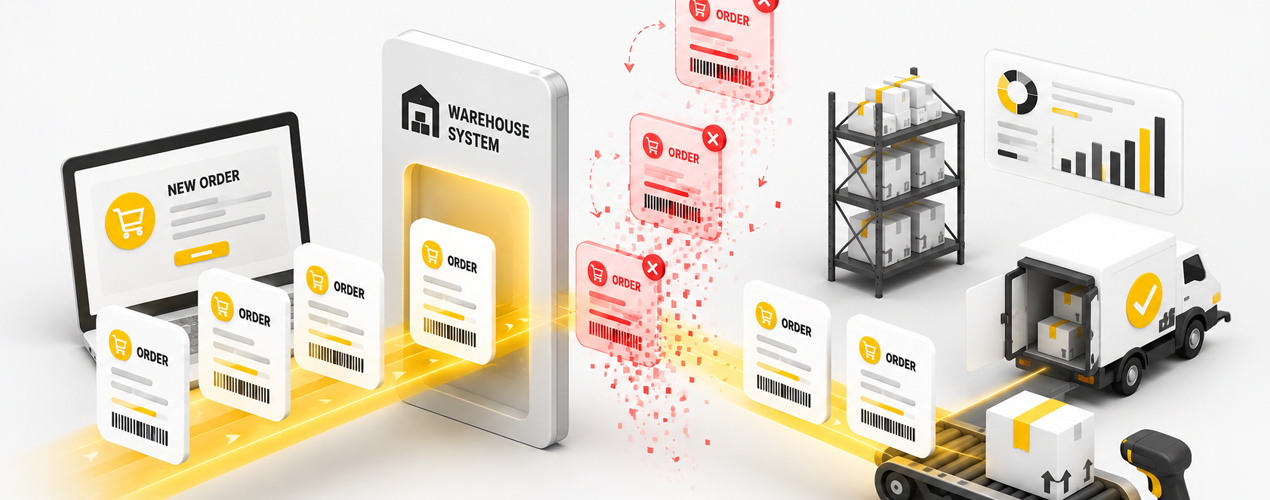
If you manage order fulfilment in a UK warehouse, you know the pattern. Some days, orders move cleanly. Picks are accurate. Shipments leave on time. Other days, errors pile up, stock counts go wrong, and delays become routine. The problem is rarely your people. It is almost always the processes and systems they work within.
This article covers why customer orders get lost, what drives the most common errors, and practical steps to fix them. We will also show how integrated platforms like Vision ERP help UK operations reduce mistakes. But the principles work for any warehouse.
Why Orders Get Lost in the First Place
Most warehouse errors follow predictable patterns rooted in how the operation is set up. Inefficient layouts, manual handoffs, and poor stock visibility create conditions where problems repeat. The six causes below are the most common. Each has a direct fix that does not require a complete overhaul.
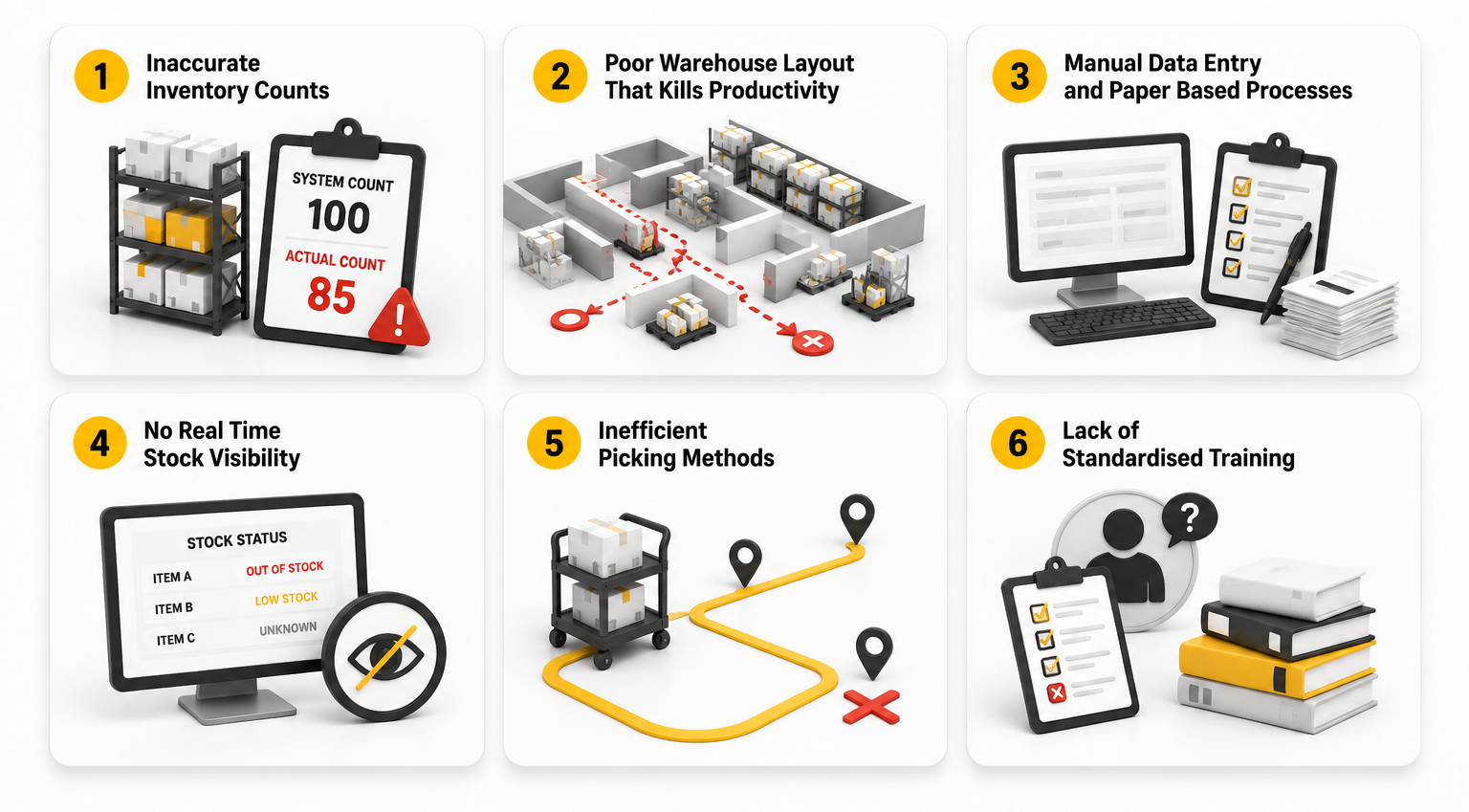
1. Inaccurate Inventory Counts
Inventory inaccuracy is the primary reason orders fail. Your system shows 10 units. A customer orders one. Your picker finds an empty bin. The order cannot be completed.
Common causes: unlogged returns, mispicks, or supplier short shipments. Over time these create stock variance that contaminates every downstream process.
The fix: Use cycle counting. Instead of a full annual stock reconciliation, count a small set of products each day. Compare physical counts to your system. Correct stock adjustments immediately. Over time, accuracy climbs above 99%. This is the fastest way to improve order fulfilment.
2. Poor Warehouse Layout That Kills Productivity
If pickers walk long distances to gather orders, you lose time. Every wasted step reduces pick rate. When orders pile up, pickers rush. Rushing causes mistakes.
The fix: Apply ABC analysis and warehouse slotting principles. Move fast selling items near the packing station. Slow movers go further away. A simple layout change can cut travel time by 30% or more.
Example: One warehouse we reviewed discovered that three products accounted for nearly 40% of all daily picks. Relocating those items closer to the packing station reduced travel time immediately.
3. Manual Data Entry and Paper Based Processes
Paper pick lists and manual stock updates are slow and error prone. A misread SKU sends a picker to the wrong location. Manual tracking creates delays.
The fix: Switch to barcode verification with handheld or RF scanning devices. Even basic scanners or mobile apps verify the correct product and quantity before the picker moves on. This single change reduces picking errors from 5% or higher to under 0.5%.
Example: A medium sized UK fulfilment centre we worked with was using printed pick sheets and handwritten labels. After introducing RF scanners, their mispick rate dropped from 4.2% to 0.3% in three weeks. The team adopted the change quickly because it eliminated the need to double check labels manually.
4. No Real Time Stock Visibility
When your sales channels, warehouse system, and shipping tools do not share live data, orders get stuck. A customer buys on your website, but the order does not appear in your warehouse system for an hour. By the time you process it, the courier has left. The order ships a day late. This is a classic symptom of limited inventory visibility.
The fix: Integrate your systems so that inventory data flows in real time. When an order is placed, it should appear in the warehouse instantly. Many UK warehouses solve this by connecting ecommerce, inventory, and shipping through a single platform like Vision ERP. As operations grow, businesses often find that maintaining multiple disconnected systems creates higher costs and more operational complexity than expected.
5. Inefficient Picking Methods
Many small and medium warehouses still use piece picking: one picker handles one order at a time, walking the entire warehouse for each order. This is slow.
The fix: Adopt batch picking or zone picking. These methods can triple throughput without adding staff.
6. Lack of Standardised Training
If every picker follows a different sequence, errors become inconsistent and hard to trace. One person scans the item immediately; another scans it later. Different sequences cause missed steps.
The fix: Document standard operating procedures for every task: receiving process, putaway process, picking, packing, shipping. Train every new hire. Review procedures annually. Consistency reduces mistakes.
Why Warehouse Errors Increase As You Scale
Many warehouse operators first notice order problems after a period of growth. The processes that worked at 500 orders per week break down at 2,000. This is not a sign of failure. It is a predictable outcome of scaling without adapting. Several factors drive this.
- SKU expansion – As you add more products, the number of unique items in the picking area grows. Pickers need more time to locate items, and the chance of grabbing the wrong variant increases. Without good warehouse slotting, slow and fast movers end up mixed together.
- Additional sales channels – Selling on your own website plus Amazon, eBay, and a wholesale channel means orders land from multiple sources. If these channels do not sync with your warehouse system in real time, double selling and overselling become common. Stock allocation across channels becomes guesswork.
- New warehouse staff – Growth requires hiring. New pickers take time to learn the layout and procedures. During that learning period, error rates rise. Without standardised training and barcode verification, those errors slip through.
- Seasonal demand spikes – Black Friday, Christmas, and promotional events push order volumes beyond normal capacity. Temporary staff are brought in quickly. Processes that rely on memory or paper lists fail under pressure.
- Marketplace integrations – Each marketplace has its own order format and shipping rules. Manually handling these increases the risk of fulfilment mistakes.
For many growing businesses, the challenge is not recognising the need for better systems but planning the transition without disrupting daily operations.
Early Warning Signs Your Warehouse Is Losing Control
Warehouse managers often miss the early clues that order problems are building. Look for these signals before errors become visible to customers.
- Inventory accuracy below 98% – If your physical counts do not match system records 98 times out of 100, you have a stock control problem. Regular inventory audits will reveal how deep the gap goes.
- Rising support tickets – An increase in customer enquiries about missing items, wrong products, or late deliveries is a leading indicator of fulfilment breakdowns.
- More than 2% order errors – A pick accuracy rate below 98% means roughly one in fifty customers receives the wrong item or quantity. That is a direct threat to retention.
- Increased picker travel time – If your team walks more than necessary each shift, warehouse inefficiency is costing you. Unoptimised warehouse slotting is often the root cause.
- Frequent stock adjustments – High volumes of stock adjustments and write offs signal that your inventory records are unreliable. Every adjustment is a symptom of a deeper process weakness.
Catching these signs early allows you to intervene before customer satisfaction drops.
The Hidden Cost of Lost Orders
Beyond direct refunds, order failures carry significant hidden costs.
- Wasted customer acquisition cost. You spent money on marketing to get that order. If fulfilment fails, that spend is lost.
- Support overhead. Every error generates emails, phone calls, and chat messages.
- Brand damage. Customers who receive wrong items often leave negative reviews.
- Lost repeat business. Acquiring a new customer costs five times more than retaining an existing one.
A real example: a UK warehouse processing 1,000 orders per month with a 5% error rate and an average order value of £50 saw direct refund costs of £2,500. Hidden costs from support, lost future sales, and reputation damage added an estimated £5,000 to £7,000 per month. That is nearly £10,000 in preventable losses.
Warehouse Metrics That Predict Order Problems
Numbers tell the story before complaints arrive. Tracking the right KPIs gives you an early warning system for order issues.
| KPI | Good | Warning |
| Inventory Accuracy | 99% and above | Below 98% |
| Pick Accuracy | 99.5% and above | Below 98.5% |
| Order Cycle Time | Under 2 hours | Over 4 hours |
| Dock To Stock Time | Under 1 hour | Over 3 hours |
| Perfect Order Rate | 98% and above | Below 95% |
| On Time Shipment | 98% and above | Below 95% |
If any of these metrics drift into the warning zone over a week, investigate before the problem compounds. Regular reviews of fulfilment performance data help you stay ahead.
Practical Steps to Fix Your Warehouse
Focus on one area at a time, measure progress, and build momentum. Below is a sequential action plan ranked by impact.
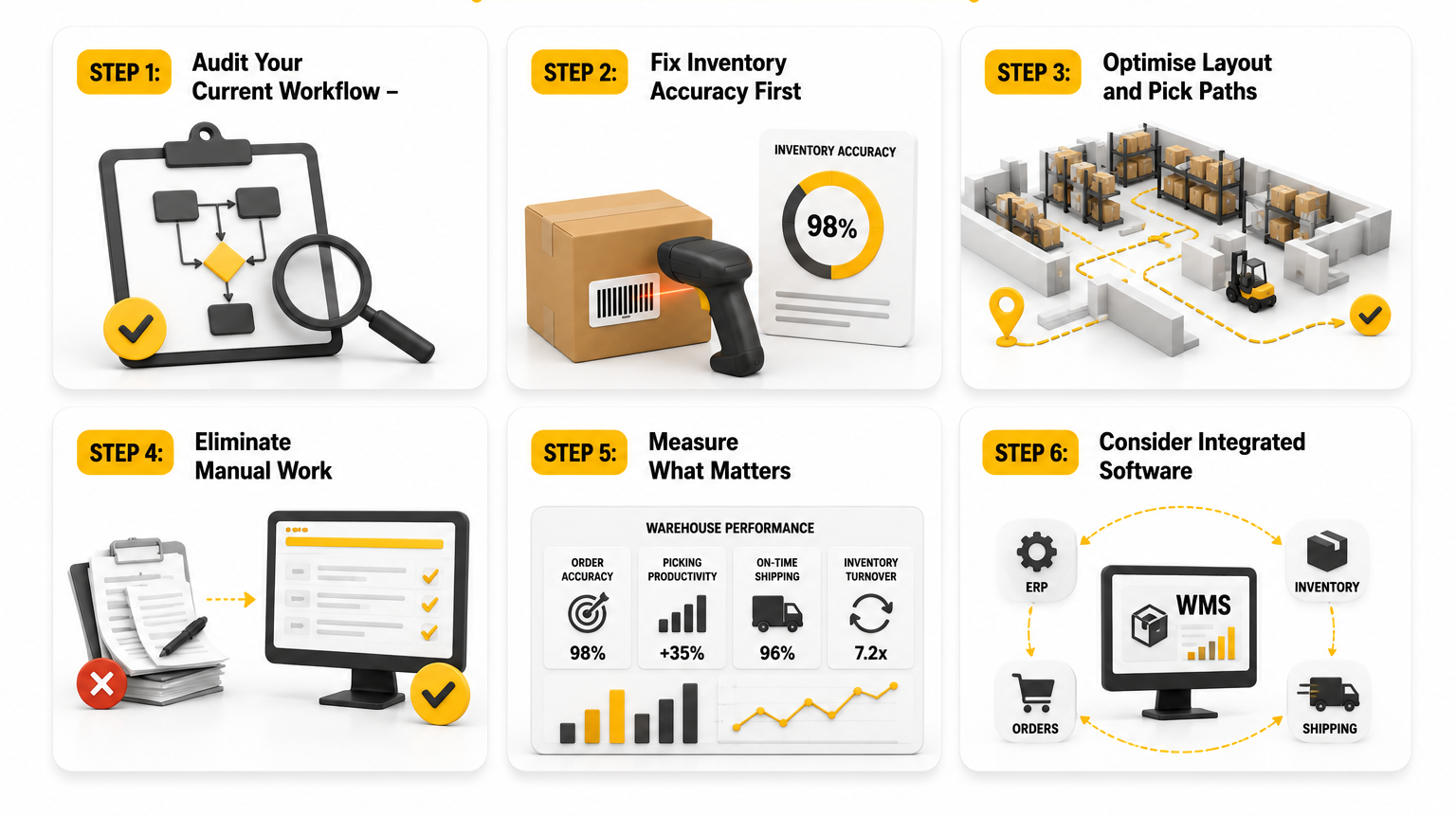
➟ Step 1: Audit Your Current Workflow – Walk your warehouse from receiving to shipping. Note every hand off, every manual data entry point, every decision. Ask your pickers where they see delays. They know exactly what slows them down.
Example: One operator we worked with found that their pickers were walking an extra 2.5 miles per shift because slow moving stock was stored in the first picking zone. Moving the top 20 items to the front saved 45 minutes per picker per day.
➟ Step 2: Fix Inventory Accuracy First – Nothing else matters if stock records are wrong. Implement cycle counting. Use RF scanning for receiving and picking. Set up a process for logging returns immediately. Get accuracy above 99% before optimising anything else.
➟ Step 3: Optimise Layout and Pick Paths – Rearrange fast moving items near the packing station. Use clear bin location labels. Map the shortest route for each pick run. Even small changes save minutes per order.
➟ Step 4: Eliminate Manual Work – Examine every manual task: printing pick lists, entering tracking numbers, updating stock. Each manual step is a risk. Automate using barcode verification and integrated software. Replace paper processes with digital systems that update stock movements in real time.
➟ Step 5: Measure What Matters – Track the key KPIs from the table above: inventory accuracy, pick accuracy, order cycle time, perfect order rate, and on time shipment percentage. Share these with your team. People improve when they see the numbers. Celebrate wins. Address problems quickly.
➟ Step 6: Consider Integrated Software – If you use separate systems for ecommerce, shipping, and inventory management, you create friction. A single platform that handles orders, inventory, and carrier services eliminates the handoffs that cause errors. Many UK warehouses are moving to integrated cloud systems like Vision ERP.
Because inventory, orders, carriers, and marketplaces share one live data source, warehouse teams eliminate many of the manual handoffs that cause stock discrepancies and shipment delays. Your team works from one view instead of bouncing between tools, which directly reduces the picking errors, stock visibility gaps, and order cycle times discussed throughout this article.
Final Advice
Losing orders does not mean your business is failing. It means your systems and processes have not kept pace with growth. That is fixable.
At Sapio Systems, we built Vision ERP for this exact scenario. It is a cloud based warehouse management platform that manages retail, warehouse, and shipping in one mobile first system. It integrates with major UK marketplaces, carriers, and payment gateways. And we provide hands on support to get you running quickly.
Book a Vision ERP demo with Sapio Systems. We can show you how to improve efficiency, reduce errors, and gain full inventory visibility in days, not months.