Growth should make your business more profitable. It should not make it harder to operate.
Yet many retailers and wholesalers reach a point where every new sales channel creates more complexity behind the scenes.
Orders arrive from different platforms, stock levels become harder to trust, fulfilment teams work across disconnected systems, and simple tasks start taking longer than they should.
The challenge is not generating orders. The challenge is managing them efficiently once they arrive.
This guide explains how centralised order management works, what features matter most, and how Vision ERP helps retailers and wholesalers manage every stage of the order lifecycle from a single platform.
What Is Order Management Software and Why You Need the Full Order Lifecycle
Order management software is the backbone of a modern retail operation. It captures, tracks, and fulfils orders from every sales channel in one place. But a good order management system does not stop at order entry. It manages the entire order lifecycle:
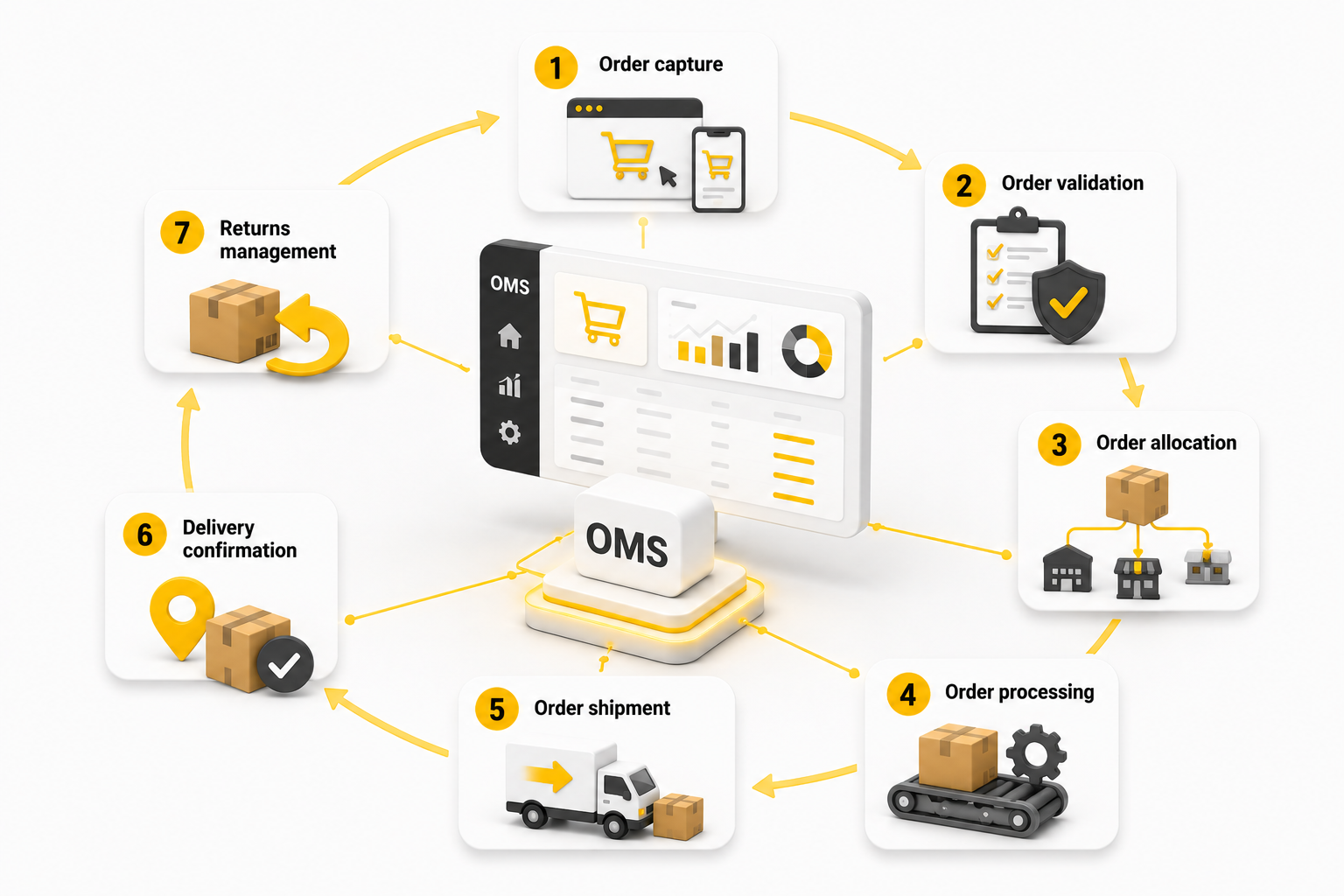
Order capture – The system receives orders from every sales channel in real time, whether from your website, a marketplace like Amazon or eBay, a wholesale portal, or a retail point of sale.
Order validation – Before an order moves to fulfilment, the system checks stock availability, validates addresses, verifies payment, and flags any issues. This prevents errors before they cost you money.
Order allocation – The system determines where each order should be fulfilled from. It considers inventory location, customer address, shipping cost, and delivery speed to assign the optimal warehouse or store.
Order processing – Once allocated, the order enters the warehouse workflow. Pick lists are generated in the most efficient sequence. Warehouse staff use barcode scanning to confirm each item picked.
Order shipment – The system generates shipping labels, compares courier rates, and updates tracking information automatically. It integrates with carriers like Evri, Yodel, DPD, Royal Mail, and USPS for UK fulfilment operations.
Delivery confirmation – When the carrier scans the parcel as delivered, the system updates the order status and notifies the customer automatically.
Returns management – If a customer returns an item, the system handles the reverse logistics: RMA generation, inspection, restocking, and refund processing. Inventory is updated across all channels instantly.
This complete order lifecycle management is what separates a basic order management system from a true retail ERP. Vision ERP covers every stage.
Demand Forecasting and Replenishment Planning
Order management software is often thought of as reactive. An order comes in, you fulfil it. But the best systems are proactive.
Vision ERP includes demand forecasting and inventory forecasting capabilities. By analysing historical sales data across all channels, the system predicts future demand for each product. It accounts for seasonality, promotions, and lead times.
With stock forecasting in place, the system generates replenishment planning recommendations. It tells you what to reorder, how many, and when. Purchase orders are created automatically and sent to suppliers.
This transforms your inventory management from reactive to strategic. You maintain stock optimisation across every warehouse. You reduce overstock on slow moving items while ensuring availability on bestsellers. You prevent both overselling and dead stock.
For retailers using Vision ERP, inventory accuracy regularly exceeds 99%. Stock control software built into the platform ensures that what you see on screen matches what you have on the shelf.
The Real Cost of Operating Without a Connected System
Most articles tell you to connect channels and sync inventory. They do not tell you what it costs to ignore the broader operation.
Inventory errors – Without stock synchronisation, overselling is inevitable. Industry data shows overselling costs retailers between 2% and 5% of revenue. For a business doing £2 million a year, that is £40,000 to £100,000 lost.
Manual order processing – Every time a staff member copies an order from one system to another, it takes about three minutes. At 100 orders a day, that is five hours of wasted labour. At £15 per hour, that is £18,000 per year.
Warehouse inefficiency – Without barcode scanning and warehouse automation, picking errors run at 3% to 5%. Each error means a return, a reship, and a dissatisfied customer. The cost adds up fast.
Fulfilment delays – Without shipping automation integrated with your order management system, you spend time copying tracking numbers back to every sales channel. That adds minutes per order and increases the chance of shipping the wrong item.
Returns chaos – Without returns management integrated into your order management software, returned items sit in a corner. Inventory updates are slow. Refunds are delayed. Customer satisfaction drops.
Reconciliation nightmares – Without accounting integration, your finance team spends days matching payments, fees, and refunds across platforms. UK VAT reconciliation becomes a manual headache.
Retailers using Vision ERP report cutting order processing time by 60% in the first month. They eliminate overselling completely. They reduce fulfilment errors by over 90%. These are real outcomes from real workflow changes.
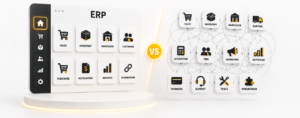
ERP vs OMS: Which One Do You Need?
As operations become more complex, many retailers and wholesalers find that an integrated ERP provides capabilities beyond a traditional OMS. Here is a clear comparison.
| Capability | Standalone OMS | Vision ERP (Integrated Platform) |
| Order centralisation | Yes | Yes |
| Order lifecycle management | Partial | Full, capture to returns |
| Real time inventory sync | Often limited | Yes, full visibility |
| Demand forecasting and replenishment | No | Yes, built in |
| Warehouse management | Add on required | Built in WMS with barcode scanning |
| Fulfilment and shipping | Partial or add on | Integrated with UK couriers |
| Returns management | Basic or add on | Full reverse logistics |
| Purchase orders and stock replenishment | No | Yes |
| Accounting and UK VAT reconciliation | No | Yes, with payment gateway tie in |
| B2B wholesale order management | No | Yes, with trade accounts and customer specific pricing |
| CRM and customer service | No | Yes, full order history per customer |
| Multi warehouse support | Rare | Yes, with allocation rules |
| Scalability | Limited by integrations | Unlimited channels and users |
| Implementation complexity | Low to medium | Medium, handled by Sapio team |
If you run a single channel with simple fulfilment, a standalone OMS may work. If you sell across multiple channels, manage stock across several locations, fulfil from stores and warehouses, handle B2B wholesale accounts, and need clean financial reporting, an ERP with built in order management is the better choice.
Order Management Software for Growing Retailers and Wholesalers
Small and mid sized retailers often assume an ERP is only for large enterprises. That is no longer true.
Vision ERP is designed for growing businesses. It is cloud based, so you pay a predictable monthly fee. There is no large upfront capital investment. Implementation takes weeks, not months. The Sapio Systems team handles every integration and data migration step.
For a retailer doing 50 to 500 orders per day across three to ten channels, Vision provides the same infrastructure that enterprise retailers use, without the enterprise price tag or complexity.
For wholesalers, Vision includes B2B order management software with trade account management, customer specific pricing, account based ordering, and wholesale fulfilment workflows.
Whether you are looking for order management software for ecommerce businesses, retail order management software, order management software for multiple sales channels, or order management software for wholesalers in the UK, Vision is built to scale with you.
How Vision ERP Centralises Your Entire Operation
Centralising orders is only effective when every part of the operation works together in real time. Here’s how the system brings your entire operation together.
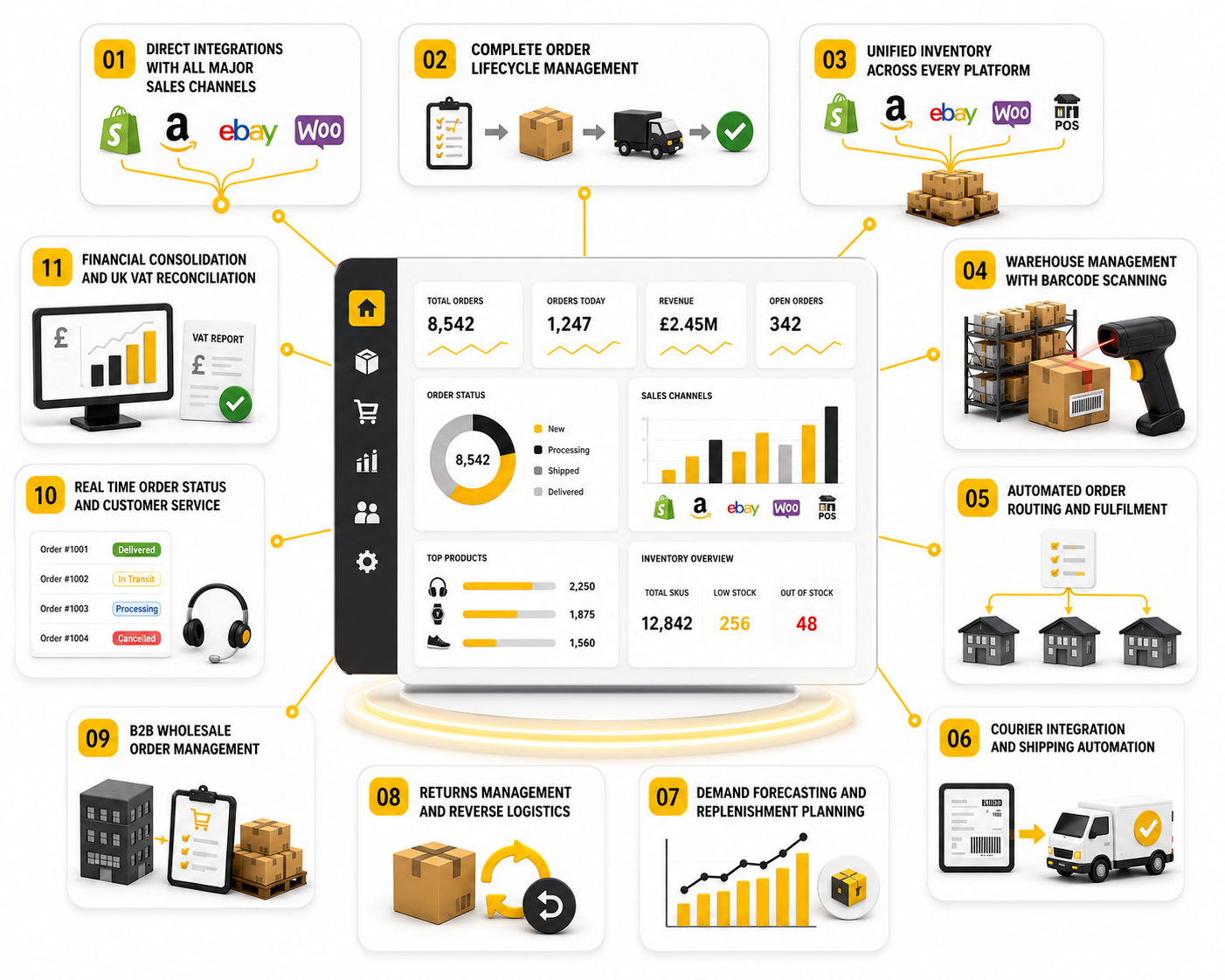
1. Direct Integrations with All Major Sales Channels
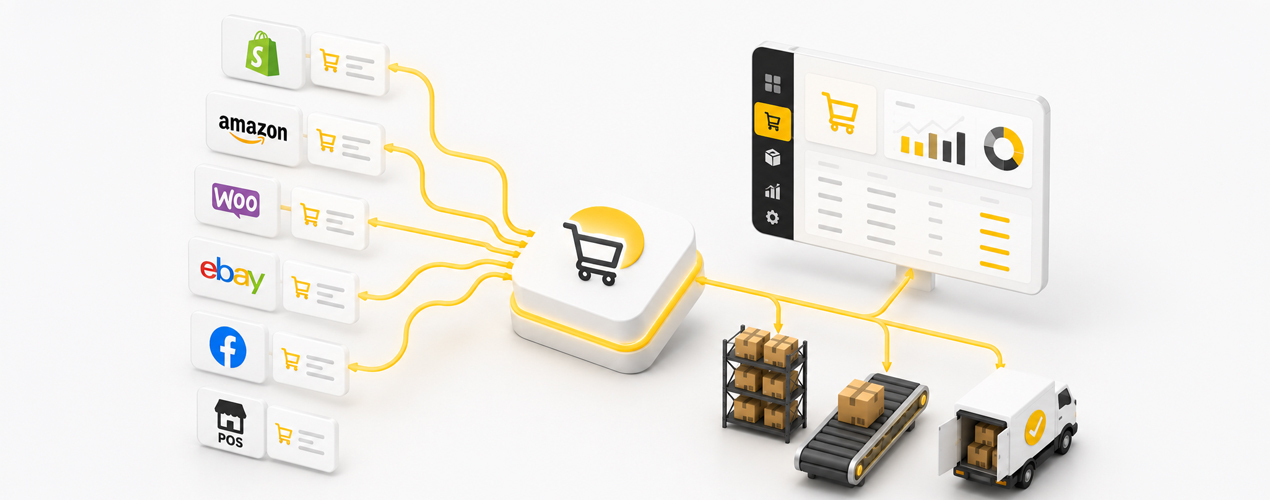
Vision connects to your website, Amazon, eBay, Shopify, Etsy, TikTok Shop, Instagram Shop, and wholesale portals. The integration is native, not an API wrapper that breaks. Sapio Systems manages the connectors so you do not have to.
Each channel sends orders into Vision in real time. A customer buys on Amazon. Within seconds, the order appears in your Vision dashboard alongside website orders and marketplace orders.
2. Complete Order Lifecycle Management
From order capture to delivery confirmation, Vision manages every stage. Orders are validated automatically for stock and payment. Allocation rules assign each order to the optimal fulfilment location. Status updates are pushed to every channel without manual effort.
3. Unified Inventory Across Every Platform
The biggest risk of multi channel selling is overselling. Vision prevents that by synchronising inventory levels across all connected channels the moment a sale happens.
If you sell a product on eBay, every other channel sees the reduced stock immediately. No more cancelling orders because your website did not know the Amazon buyer took the last unit.
For businesses that operate multiple warehouses, Vision tracks stock by location. It can route orders to the nearest warehouse based on customer postcode, reducing shipping time and cost.
4. Warehouse Management with Barcode Scanning
Vision includes a full warehouse management system. Warehouse staff use handheld devices to scan items during receipt, putaway, picking, packing, and shipping.
Barcode scanning eliminates picking errors. The system guides staff to the correct location and verifies each item before it ships. This alone reduces fulfilment errors by over 90%.
5. Automated Order Routing and Fulfilment
Once orders are centralised, you define rules for fulfilment. Vision can group orders by carrier, by shipping method, or by warehouse zone. It generates pick lists in the most efficient sequence.
For retail stores that also fulfil online orders, Vision supports store pickup and ship from store. The system knows which store has the item and assigns the order accordingly.
6. Courier Integration and Shipping Automation
Vision integrates with Evri, Yodel, DPD, Royal Mail, and USPS, and other major couriers to generate labels, compare rates, and update tracking automatically. No more copying tracking numbers back to sales channels. The system does it for you.
7. Demand Forecasting and Replenishment Planning
Vision analyses sales data to predict future demand. The system generates stock forecasting recommendations and creates purchase orders automatically. You maintain stock optimisation without manual effort.
8. Returns Management and Reverse Logistics
Returns are part of retail. Vision handles the entire return lifecycle: RMA generation, inspection, restocking, and refund processing. When a returned item is scanned back into stock, inventory is updated across all channels instantly.
9. B2B Wholesale Order Management
For wholesalers, Vision supports trade account management, customer specific pricing, account based ordering, and wholesale fulfilment workflows. B2B customers can place orders through their own portal with negotiated prices.
10. Real Time Order Status and Customer Service
Customers today expect tracking within minutes of placing an order. Vision updates every channel automatically with tracking numbers and delivery status.
Your customer service team sees the complete order history from one screen. They do not need to log into Amazon Seller Central, then Shopify, then eBay to answer a query. They work faster, resolve issues quicker, and improve your seller ratings.
11. Financial Consolidation and UK VAT Reconciliation
Centralising orders is not just about operational efficiency. It also cleans up your accounting. Vision ties every order to the correct payment gateway, marketplace fee, and shipping cost. UK VAT reconciliation is handled automatically.
Reconciliation becomes a single report instead of a multi platform puzzle. Your finance team saves hours every week and reduces revenue leakage from unclaimed fees or incorrect tax calculations.
Why Vision ERP Is the Best Fit for UK Retailers and Wholesalers
Most ERP platforms require heavy customisation, long implementation timelines, and ongoing technical support. Vision is designed to be fast to set up and easy to operate. The team at Sapio handles integrations, data migration, and ongoing updates.
The platform is mobile first. Warehouse staff can pick, pack, and ship using handheld devices. Managers can check order status from their phone. The mobile interface is not a stripped down version. It is the full system.
Scalability is built in. Start with two channels and grow to ten. Vision adds new integrations without downtime. The system is cloud based, so you never worry about server upgrades or security patches.
Book a free 30 minute systems review to see if Vision ERP fits your business